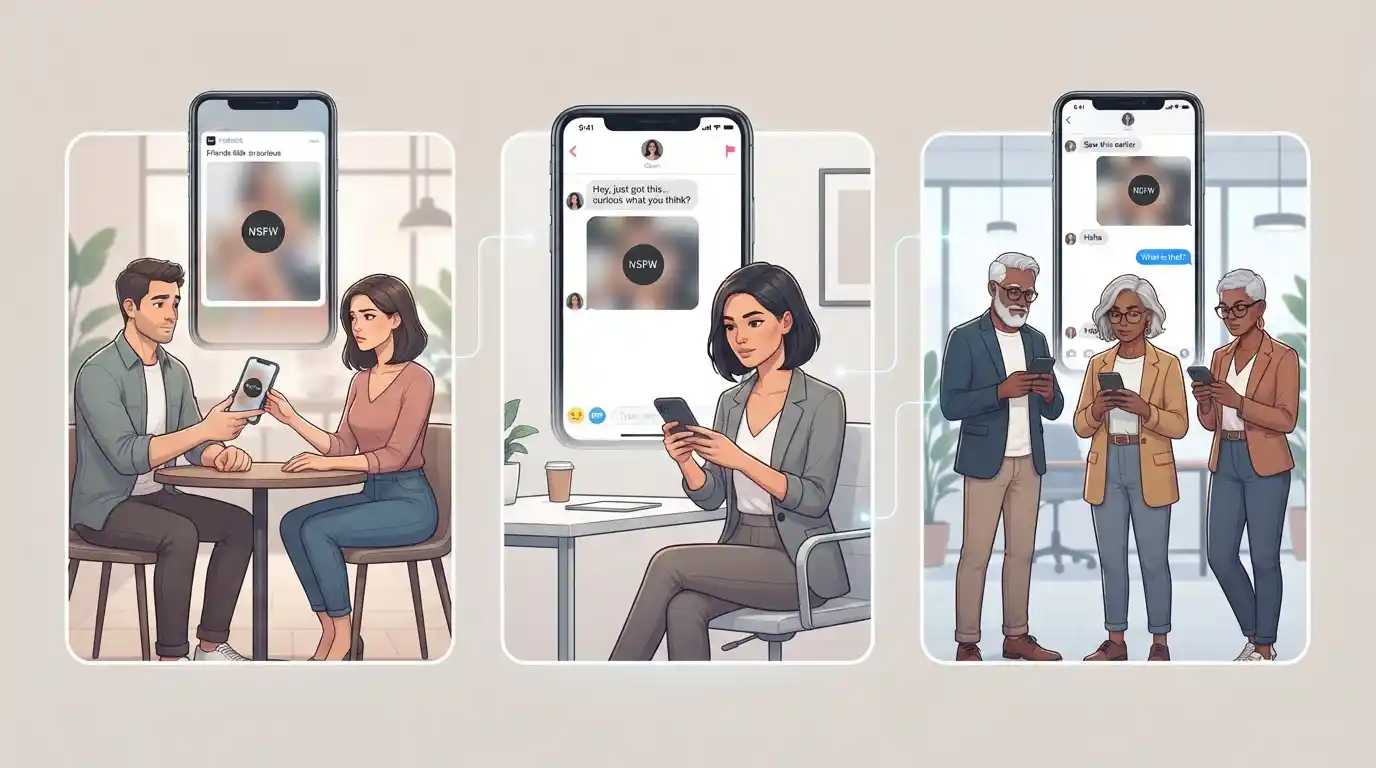
NSFW terminology refers to internet words, abbreviations, and warning labels used for content that may not be appropriate to view at work or in other public or professional settings. The main term is NSFW, which stands for “Not Safe For Work.”
Key Takeaways
- NSFW means “Not Safe For Work.”
- NSFW is an internet abbreviation and content-warning label, rather than ordinary texting slang.
- It warns that a post, image, video, link, message, or other material may be inappropriate for a workplace or public setting.
- NSFW can refer to adult material, graphic or disturbing content, strong language, offensive material, or other content someone may not want others to see.
- “Not Suitable For Work” is also used as a near-equivalent expansion.
- Related terms such as SFW, NSFL, and CW can provide different kinds of content warnings.
NSFW Terminology Meaning in Text
In text and online communication, NSFW terminology describes the shorthand people use to warn others about potentially inappropriate content. The most important term in this group is NSFW, meaning “Not Safe For Work.”
NSFW is best understood as a content warning, not as a description of someone’s personality or behavior. Someone might put “NSFW” before a link, photo, video, meme, or post so the recipient knows to consider where they are before opening it.
The warning can cover different types of material. Depending on the context, it may indicate adult themes, nudity, graphic violence, profanity, offensive material, or other content that could be inappropriate in a workplace, classroom, family setting, or other public environment.
In a message, for example:
“NSFW — open this later.”
The sender is essentially saying: “Be careful where you open this because it may not be appropriate for your current surroundings.”
NSFW is therefore an internet abbreviation, messaging shorthand, and online warning label rather than a term that automatically tells you exactly what the content contains.
What Does NSFW Terminology Stand For?
The main abbreviation is:
NSFW = Not Safe For Work
Another recognized expansion is:
NSFW = Not Suitable For Work
“Not Safe For Work” is the standard expansion, while “Not Suitable For Work” conveys essentially the same warning.
The phrase is designed to tell someone that the material may be unsuitable to view in a professional environment. It does not necessarily identify the exact type of content.
How Is NSFW Terminology Used?
NSFW terminology is mainly used as a quick warning in digital communication.
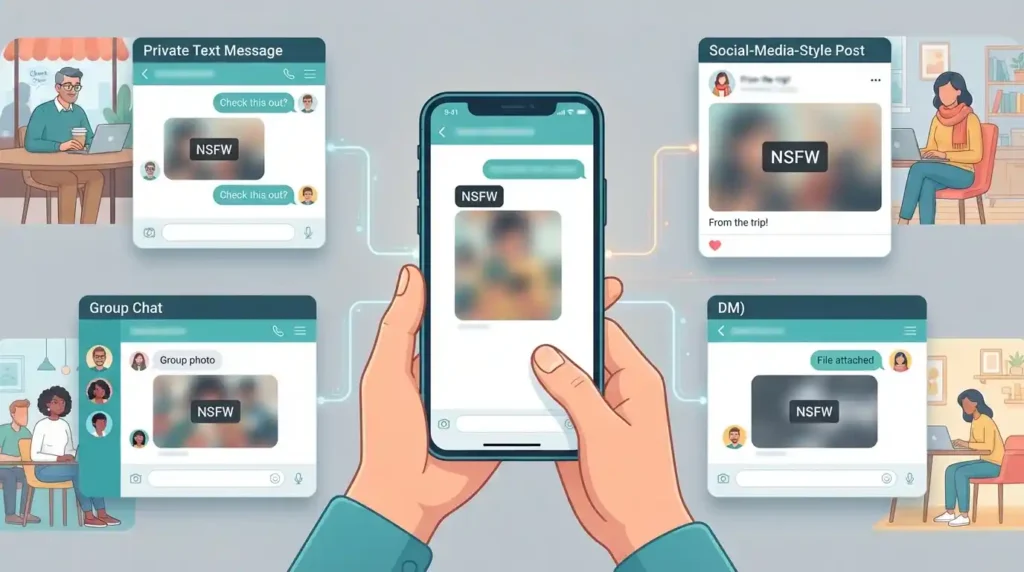
Text Messages
Someone may write:
“I found the video. NSFW though.”
The warning tells the recipient to be cautious before opening it.
DMs
A person might send:
“NSFW link — check it later.”
Here, NSFW works as a short warning attached to the shared material.
Group Chats
NSFW can help alert several people before they open an image, video, or link.
“Heads up, this meme is NSFW.”
Social Media
Users may place NSFW alongside a post, caption, link, or other shared material to indicate that it may not be suitable for public viewing.
Forums and Online Communities
NSFW has long been used as an internet warning for links and shared content that may be inappropriate for formal or controlled environments.
NSFW Terminology in Different Contexts
The meaning of NSFW stays fairly consistent, but the reason for the warning depends on the surrounding content.
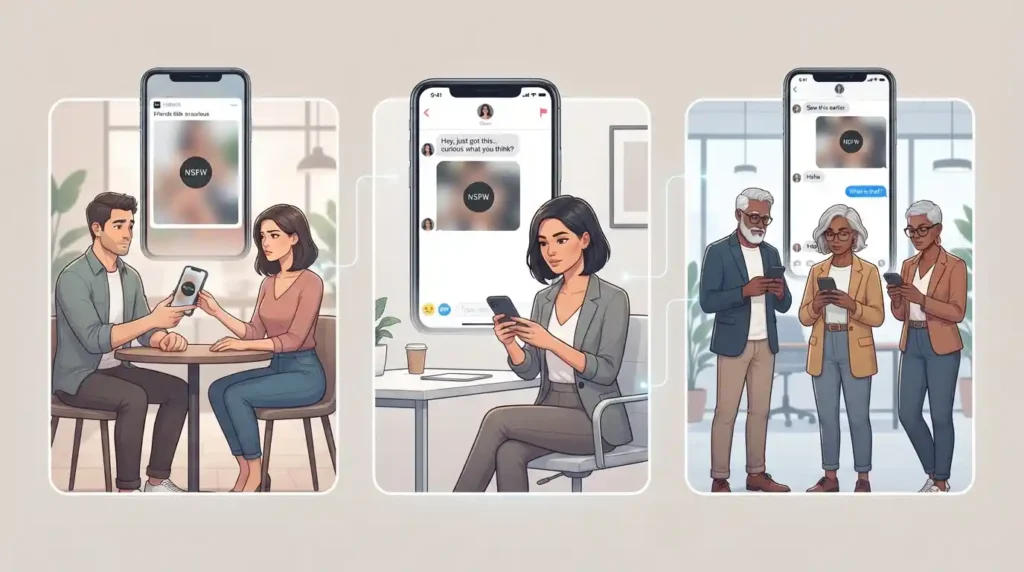
From a Friend
A friend may use NSFW simply to give you a heads-up before sharing something inappropriate or potentially embarrassing.
From a Guy or Girl
NSFW does not have a different meaning based on whether the sender is a guy or a girl. The abbreviation itself remains “Not Safe For Work.”
From a Crush
If someone sends you an NSFW warning, the abbreviation alone does not prove flirting, attraction, or romantic interest. The meaning depends on the content and the rest of the conversation.
In Dating
In dating conversations, NSFW may be used to warn that a shared post, image, joke, or other material contains mature or inappropriate themes. The label itself does not establish romantic intent.
In a Group Chat
A group chat, NSFW can function as a general courtesy warning so members know to check their surroundings before viewing something.
In Social Media Comments
Someone may use “NSFW” to warn other users about the nature of content linked or referenced in a comment.
Context still matters. The abbreviation tells you that caution may be needed, but it does not always tell you precisely why.
Real Chat Examples
Here are realistic examples showing how NSFW terminology can appear in everyday online communication:
- Friend: “I found that clip you wanted. NSFW btw.”
You: “Got it, I’ll watch it later.” - Friend: “NSFW link ahead 😅”
You: “Thanks for the warning.” - Coworker: “I came across a weird meme. Definitely NSFW.”
You: “Probably not opening that at my desk.” - Friend: “Don’t click this while you’re in the office. NSFW.”
You: “Noted. Saving it for later.” - Group chat: “NSFW, everyone.”
Reply: “Appreciate the heads-up.” - Friend: “This post is NSFW.”
Reply: “What kind of warning are we talking about?” - DM: “Sending you the link, but it’s NSFW.”
Reply: “I’ll check it when I’m somewhere private.” - Friend: “NSFW meme incoming.”
Reply: “Okay, I’ll wait until I’m off work.” - Group chat: “That picture is probably NSFW.”
Reply: “Good to know before I open it.” - Friend: “This video should come with an NSFW warning.”
Reply: “That sounds like a sign to wait.” - Friend: “NSFW. Seriously.”
Reply: “Message received 😂” - DM: “Quick warning: NSFW.”
Reply: “Thanks for letting me know.” - Friend: “I sent the link. It’s NSFW, so don’t open it around everyone.”
Reply: “I’ll check it later.” - Group chat: “Can someone mark this NSFW?”
Reply: “Yeah, that would be a good idea.” - Friend: “This definitely belongs under NSFW.”
Reply: “Understood.” - Friend: “NSFW content in the next message.”
Reply: “I’m somewhere private now.” - Friend: “Would you consider this NSFW?”
Reply: “Probably, depending on where you’re viewing it.” - DM: “NSFW warning before you tap that.”
Reply: “Thanks for the warning.”
How to Reply to NSFW Terminology
Your response depends on what the sender is warning you about and your relationship with them.
Casual Replies
- “Got it.”
- “Thanks for the warning.”
- “I’ll check it later.”
- “Noted.”
- “Good heads-up.”
Friendly Replies
- “Appreciate the warning 😂”
- “Okay, I’ll save it for later.”
- “You really had to warn me, huh?”
- “Thanks for looking out.”
Funny Replies
- “My workplace thanks you.”
- “Definitely not opening that during the meeting.”
- “Adding that to my ‘watch later’ list.”
- “Warning received loud and clear.”
Neutral Replies
- “Thanks for letting me know.”
- “Understood.”
- “I’ll wait until I’m somewhere appropriate.”
- “Okay, I’ll be careful.”
Flirty/Relationship Replies
NSFW itself does not automatically make a conversation romantic or sexual. If the broader conversation is already flirtatious, you can respond according to that existing tone, but avoid assuming intent from the abbreviation alone.
What Tone Does NSFW Terminology Have?
NSFW usually has a cautionary, direct, and informal tone.
Common tones include:
- Cautionary: It warns someone before they view something.
- Direct: The abbreviation communicates the warning quickly.
- Informal: It is mainly associated with internet and digital communication.
- Neutral: The label itself does not necessarily judge the content.
- Context-dependent: The seriousness depends on what the warning describes.
For example, “NSFW” attached to a mildly inappropriate joke may be less serious than the same label attached to highly disturbing material.
Is NSFW Terminology Rude or Offensive?
NSFW is not itself a rude or offensive expression. It is a warning label.
It can be appropriate in casual online conversations, especially when sharing content that others may not want to open in a public or professional environment.
However, NSFW is informal, so it is usually better suited to:
- Text messages
- Friend groups
- DMs
- Online communities
- Social media
- Casual digital communication
For professional communication, a more specific and neutral content warning may sometimes be clearer.
Also, seeing the NSFW label does not automatically mean the underlying material is illegal, dangerous, or necessarily sexual. The label simply indicates that the content may be unsuitable for a particular setting.
Other Meanings of NSFW Terminology
NSFW has one dominant meaning, but several related warning terms are useful to understand.
SFW
SFW means “Safe For Work.” It is generally used for content considered appropriate to view in a workplace or other professional setting.
NSFL
NSFL means “Not Safe For Life.” It is used for material considered especially disturbing or graphic. It is a stronger warning than ordinary NSFW.
CW
CW commonly means “Content Warning.” It is a broader label that alerts people that material may contain a potentially upsetting or sensitive subject.
TW
TW commonly means “Trigger Warning.” It is generally used when content may be distressing to people who have particular sensitivities or past experiences.
These terms overlap in purpose, but they are not interchangeable in every situation.
Common Mistakes About NSFW Terminology
Assuming NSFW Always Means Sexual Content
Sexual or adult material is one common reason for an NSFW warning, but NSFW can also cover graphic violence, profanity, offensive material, or other content unsuitable for a particular setting.
Assuming NSFW Tells You Exactly What Is Inside
It does not. NSFW is a broad warning rather than a detailed description.
Assuming NSFW Is Romantic
If someone sends an NSFW-tagged post, that alone does not establish flirting or sexual interest. Look at the surrounding conversation and the actual context.
Treating NSFW as a Professional Acronym
NSFW is an internet abbreviation and content-warning label. It is not normally the kind of formal business abbreviation you would use in a professional report.
Assuming Every NSFW Label Means the Same Level of Sensitivity
The warning can cover a wide range of material, so the context still matters.
NSFW Terminology and Related Slang
| Term | Meaning | Common Use |
|---|---|---|
| NSFW | Not Safe For Work | Warning about potentially inappropriate content |
| SFW | Safe For Work | Indicating content is generally appropriate for work |
| NSFL | Not Safe For Life | Warning about especially disturbing or graphic content |
| CW | Content Warning | General warning about potentially sensitive material |
| TW | Trigger Warning | Warning about potentially distressing subjects |
People Also Ask About NSFW Terminology
What does NSFW stand for?
NSFW stands for “Not Safe For Work.” It is an internet abbreviation used to warn that content may not be appropriate to view in a workplace or other public or professional setting.
Does NSFW always mean adult content?
No. NSFW can refer to adult material, but the label can also warn about graphic violence, profanity, offensive material, or other content that may be inappropriate for a particular environment.
Is NSFW a slang word?
NSFW is better described as internet slang, an initialism, or an online content-warning abbreviation. It functions mainly as a warning label rather than as an ordinary conversational word.
What is the opposite of NSFW?
SFW, meaning “Safe For Work,” is commonly used as the opposite of NSFW. It indicates that content is generally considered appropriate to view in a workplace or similar setting.
What is the difference between NSFW and NSFL?
NSFW broadly warns that content may be inappropriate for work or public viewing. NSFL is generally used for material considered particularly disturbing or graphic, making it a stronger warning.
Does NSFW mean something different in texting?
Usually, no. In a text message, NSFW still means “Not Safe For Work.” The main difference is that people may use it informally before sending a photo, video, link, meme, or other material.
Can NSFW mean “Not Suitable For Work”?
Yes. “Not Suitable For Work” is a recognized variation of the phrase, although “Not Safe For Work” is the standard expansion.
Conclusion
NSFW terminology centers on NSFW, meaning “Not Safe For Work.” It is an informal internet warning used to signal that content may be inappropriate for workplaces, public settings, or other environments where viewing it could be uncomfortable or unsuitable.
The term can cover different kinds of sensitive material, so the label alone does not reveal exactly what is behind it. In texting and social media, NSFW is mainly a quick, cautionary warning. Related terms such as SFW, NSFL, CW, and TW can provide more specific context when needed.

Mila Parker brings three years of writing experience to the craft of puns, jokes, and concise wordplay. Her subject range moves through food, animals, seasonal themes, technology, entertainment, and trending topics. She studies relevant terminology, connects words through double meanings and associations, then adjusts setups and punchlines to keep each joke clear and well structured.