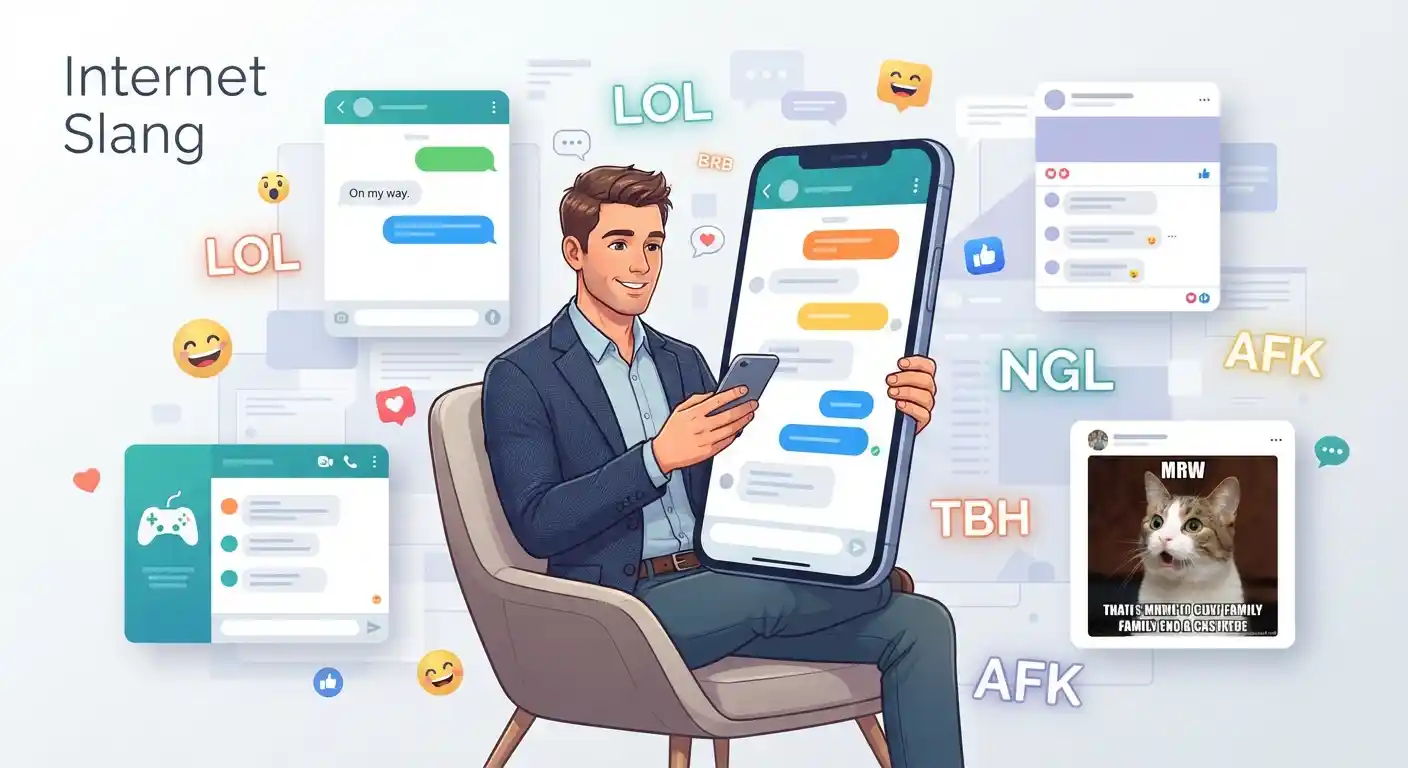
Internet slang is informal language used in online communication, including abbreviations, acronyms, shortened words, expressions, memes, and phrases that develop or become popular on the internet. It appears in texts, DMs, comments, chats, gaming, and social media.
Key Takeaways
- Internet slang is informal language used in online and digital communication.
- It can include acronyms, abbreviations, shortened words, slang expressions, memes, and symbols.
- Common examples include LOL, BRB, IDK, TBH, NGL, BTW, and AFK.
- Internet slang is usually casual and depends heavily on context.
- A term can have different meanings depending on the conversation, platform, or online community.
- Internet slang is generally better suited to casual communication than formal school, workplace, or professional writing.
Internet Slang Meaning in Text
Internet slang refers to informal words and expressions people use when communicating online. In text messages and chats, it can make communication shorter, more casual, humorous, expressive, or connected to a particular online community.
Internet slang is broader than texting abbreviations. It can include classic shortcuts such as LOL and BRB, newer expressions such as no cap or rizz, gaming terminology, meme language, reaction phrases, and community-specific expressions.
The term is sometimes also called internet shorthand, online slang, cyber-slang, netspeak, or digital slang.
Unlike a formal language system, internet slang does not have one fixed vocabulary. Meanings can change over time, and a term that is familiar in one online community may be unfamiliar to someone outside it.
Is Internet Slang the Same as Texting Slang?
Not exactly.
Texting slang is mainly associated with messages and chats, while internet slang covers a wider range of online communication. Internet slang can appear in texts, social media comments, gaming chats, forums, memes, captions, livestreams, and other digital spaces.
For example:
- BRB — Be right back
- TBH — To be honest
- NGL — Not gonna lie
- AFK — Away from keyboard
- No cap — Used to emphasize that something is true or sincere
- Rizz — Slang related to romantic charm or appeal
What Does Internet Slang Stand For?
Internet slang does not stand for a specific phrase. It is a general term for informal language that is used or popularized through internet communication.
The word slang describes informal language, while internet identifies the digital environment where these words and expressions are commonly used or spread.
Some forms of internet slang are acronyms or abbreviations that do have full forms. For example:
| Term | Full Form | Typical Meaning |
|---|---|---|
| LOL | Laughing out loud | Showing amusement |
| BRB | Be right back | Temporarily leaving |
| IDK | I don’t know | Expressing uncertainty |
| TBH | To be honest | Introducing an honest opinion |
| NGL | Not gonna lie | Emphasizing sincerity |
| BTW | By the way | Adding another point |
| AFK | Away from keyboard | Temporarily unavailable online |
So, internet slang itself has no full form, even though many individual slang terms do.
How Is Internet Slang Used?
Internet slang is used to communicate quickly and casually. The exact type of slang depends on the conversation and the online community.
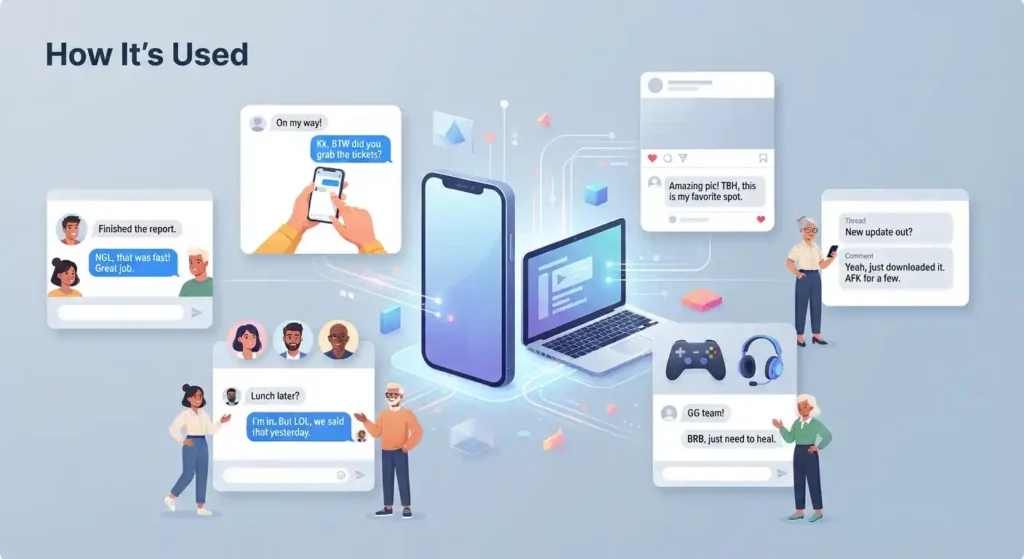
Text Messages
People commonly use short forms in everyday texting:
“IDK what time we’re leaving.”
“BRB, grabbing food.”
“TBH, I liked the first movie better.”
DMs
Direct messages often use casual slang because they resemble ordinary conversations between friends or acquaintances.
“NGL that outfit looks great.”
“WYD tonight?”
Group Chats
Group chats can develop their own shorthand, jokes, and recurring expressions.
“LOL you guys are ridiculous.”
“BTW, we’re meeting at 7.”
Social Media
Slang frequently appears in captions, replies, comments, and posts.
“That outfit ate.”
“No cap, this is actually good.”
Gaming
Online gaming has its own vocabulary, including terms and abbreviations that may be unfamiliar outside gaming communities.
For example, AFK can tell other players that someone is temporarily away from their keyboard or device.
Memes and Online Communities
Internet slang can also spread through memes, fandoms, forums, streaming communities, and other online groups. In these settings, the meaning may depend on shared knowledge rather than the literal meaning of the individual words.
Internet Slang in Different Contexts
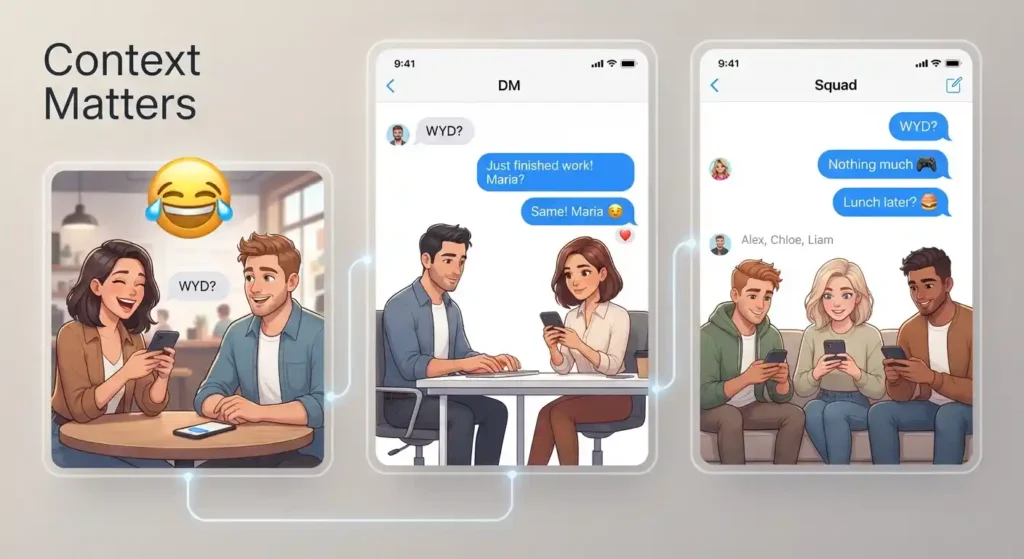
Internet slang usually needs to be interpreted from the surrounding conversation.
From a Friend
A friend using slang is usually keeping the conversation casual.
“NGL, that was hilarious 😂”
Here, NGL simply introduces an honest reaction.
From a Crush
Slang by itself does not prove romantic interest.
For example:
“WYD later?”
could simply mean “What are you doing later?” The relationship and surrounding conversation provide more information than the slang itself.
In Dating
Internet slang can make dating conversations feel more relaxed or playful, but the same expression can have different meanings depending on the people involved.
In a Group Chat
A slang term may have a meaning specific to the group. An inside joke or abbreviation may make perfect sense to regular members but confuse someone who has just joined.
In Social Media Comments
Comments can be especially context-dependent because slang is often mixed with memes, emojis, sarcasm, and references to current online culture.
Does Gender Change the Meaning?
Usually, no.
Internet slang does not automatically have one meaning when a guy uses it and another when a girl uses it. To understand someone’s intent, consider the wording, previous messages, punctuation, emojis, relationship, and overall conversation.
Real Chat Examples
Here are realistic examples showing how internet slang can appear in everyday online conversations:
- Alex: “What are you doing tonight?”
Sam: “IDK yet.” - Mia: “Can you wait a sec?”
Jake: “BRB, getting water.” - Chris: “TBH, I didn’t like the ending.”
- Taylor: “NGL, that was one of the funniest movies I’ve seen.”
- Jordan: “BTW, don’t forget your charger.”
- Sam: “Are you coming?”
Alex: “OMW.” - Mia: “WYD?”
Taylor: “Just watching TV.” - Chris: “LMK when you get home.”
- Jordan: “LOL I can’t believe you actually did that.”
- Alex: “I have to go AFK for a few minutes.”
- Sam: “NVM, I figured it out.”
- Mia: “JK 😂 I wasn’t actually mad.”
- Taylor: “That new song is fire.”
- Chris: “No cap, that restaurant was amazing.”
- Jordan: “Bet. I’ll see you at 8.”
- Alex: “IIRC, we’ve been here before.”
- Sam: “SMH, you forgot the tickets again.”
- Mia: “IDK why everyone loves that show.”
- Chris: “NGL, I thought you were joking.”
- Taylor: “WYD after work?”
- Jordan: “BRB, my food just arrived.”
- Alex: “TBH, I’d rather stay home tonight.”
- Sam: “LOL that’s actually wild.”
- Mia: “LMK if you need anything.”
- Chris: “AFK for dinner. Be back soon.”
How to Reply to Internet Slang
There is no single reply to internet slang because internet slang is a category rather than one particular message. The best response depends on the specific slang term and what the person is saying.
Casual Replies
- “Yeah, I get you.”
- “Same honestly.”
- “Lol exactly.”
- “Gotcha.”
- “Fair enough.”
Friendly Replies
- “Haha, seriously!”
- “I know, right?”
- “That makes sense.”
- “Same here 😂”
Funny Replies
- “Okay, internet dictionary 😂”
- “I had to decode that one.”
- “You lost me for a second 😂”
- “Adding that to my vocabulary.”
Neutral Replies
- “What does that mean here?”
- “I haven’t seen that one before.”
- “Can you explain what you mean?”
- “Got it.”
Flirty or Relationship Replies
If a slang term appears in a romantic conversation, respond to the actual message and context, rather than assuming the slang itself is flirting.
For example:
“WYD tonight?”
A casual response could be:
“Not much. Why?”
A more playful response could be:
“Depends. What did you have in mind? 😉”
What Tone Does Internet Slang Have?
Internet slang is generally casual and informal, but individual terms can carry very different tones.
Depending on the expression, internet slang can sound:
- Casual
- Friendly
- Playful
- Humorous
- Sarcastic
- Excited
- Direct
- Informal
- Community-specific
- Context-dependent
For example, LOL can soften a message or show amusement, while SMH can express disappointment or disbelief. A term such as TBH signals that the speaker is about to give an honest opinion.
The surrounding message matters. The same slang term can sound playful between friends but less appropriate in a serious conversation.
Is Internet Slang Rude or Offensive?
Internet slang is not automatically rude or offensive. Most common slang is simply informal.
It is generally suitable for:
- Texting friends
- Group chats
- Casual DMs
- Social media comments
- Informal online conversations
It may be less appropriate for:
- Formal business emails
- Job applications
- Academic assignments
- Professional reports
- Official documents
- Serious workplace communication
Some individual slang expressions can also be vulgar, insulting, sexual, or offensive. That is a property of the particular expression, not of internet slang as a whole.
When communicating professionally, standard language is usually the safer choice unless the setting clearly supports a casual style.
Other Meanings of Internet Slang
Internet Slang as a Broad Language Category
The phrase internet slang is primarily a category name rather than an acronym with several competing expansions.
It can refer to language that originated online as well as older slang that became widely used through digital communication.
Internet Slang in Gaming
Gaming communities use many specialized terms, abbreviations, and expressions. Some are specific to multiplayer games, while others have spread into general online conversation.
For example, AFK originally describes being away from a keyboard or temporarily unavailable in an online setting.
Internet Slang on Social Media
Social media can accelerate the spread of slang. A phrase may begin within a particular community and later become familiar across multiple platforms.
However, a term’s meaning can still depend on the community where it appears.
Common Mistakes About Internet Slang
Assuming Every Short Word Is an Acronym
Not all internet slang is an acronym. Some terms are ordinary words used with a new meaning, while others are abbreviations, phrases, memes, or expressions.
Assuming There Is Only One Meaning
A slang term can have different meanings in different communities. Context should be checked before deciding what someone means.
Assuming Slang Proves Romantic Interest
A casual abbreviation, emoji, or slang expression does not automatically indicate flirting, attraction, love, jealousy, or rejection.
Treating Internet Slang as Formal English
Internet slang is generally informal. A phrase that works perfectly in a group chat may not belong in a professional email or academic paper.
Assuming Slang Never Changes
Internet language evolves. Meanings can become more common, less common, or change depending on how communities use a term.
Internet Slang and Related Slang
These terms are closely connected to internet slang and digital communication:
| Term | Meaning | Common Use |
|---|---|---|
| Text slang | Informal shorthand used in messages | Texts and chats |
| Chat slang | Informal language used in online conversations | Group chats and messaging |
| Internet shorthand | Shortened online expressions | Digital communication |
| Social media slang | Informal language popular on social platforms | Comments, captions, posts |
| Gaming slang | Specialized informal gaming vocabulary | Multiplayer games and gaming chats |
| Acronym | A shortened expression formed from letters | Texts, chats, online posts |
| Abbreviation | A shortened form of a word or phrase | Messaging and online communication |
People Also Ask About Internet Slang
What is an example of internet slang?
Common examples include LOL for “laughing out loud,” BRB for “be right back,” IDK for “I don’t know,” and TBH for “to be honest.” Newer slang can also include informal words and expressions rather than abbreviations.
Is internet slang the same as texting slang?
No. Texting slang is mainly associated with text messages and chats, while internet slang is a broader category that includes language used across social media, gaming, forums, comments, memes, and messaging.
Why do people use internet slang?
People use internet slang to communicate casually, express reactions, shorten messages, add humor, and participate in shared online culture. Some expressions also help people identify with particular communities.
Is internet slang proper English?
Internet slang is part of informal communication, but it is not usually appropriate for formal writing. Whether it is suitable depends on the audience, purpose, and setting.
Does internet slang have a dictionary?
There are dictionaries and glossaries that document internet slang, but the vocabulary is constantly changing. No single dictionary can be expected to contain every current expression or community-specific meaning.
Can internet slang have multiple meanings?
Yes. Some abbreviations and expressions have multiple meanings. The conversation, platform, community, and surrounding words can help determine which interpretation is intended.
Is internet slang only used by young people?
No. Internet slang is used by people of different ages and backgrounds. Familiarity with a particular term depends more on someone’s online communities, interests, and communication habits than on age alone.
Can internet slang be used at work?
Some casual workplace conversations may use familiar slang, especially in informal chats, but professional emails, reports, and formal communication generally call for clearer standard language. When unsure, use straightforward wording.
Conclusion
Internet slang is informal language used across digital communication, including texts, DMs, social media, gaming, comments, and online communities. It includes abbreviations and acronyms such as LOL and BRB, but also covers slang words, phrases, memes, and community-specific expressions.
Internet slang does not have a single full form because it is a broad category rather than an acronym. Its tone is usually casual, and its meaning can depend heavily on context. For that reason, understanding the surrounding conversation is often more important than interpreting a slang term in isolation.

Writing puns and jokes for three and a half years has given Grace Collins experience working with language across varied subjects. As a writer, she covers food, animals, seasonal themes, technology, entertainment, and trending topics. Grace gathers subject-specific terms, explores word associations, and polishes joke structures to improve phrasing, punchlines, and comedic timing.