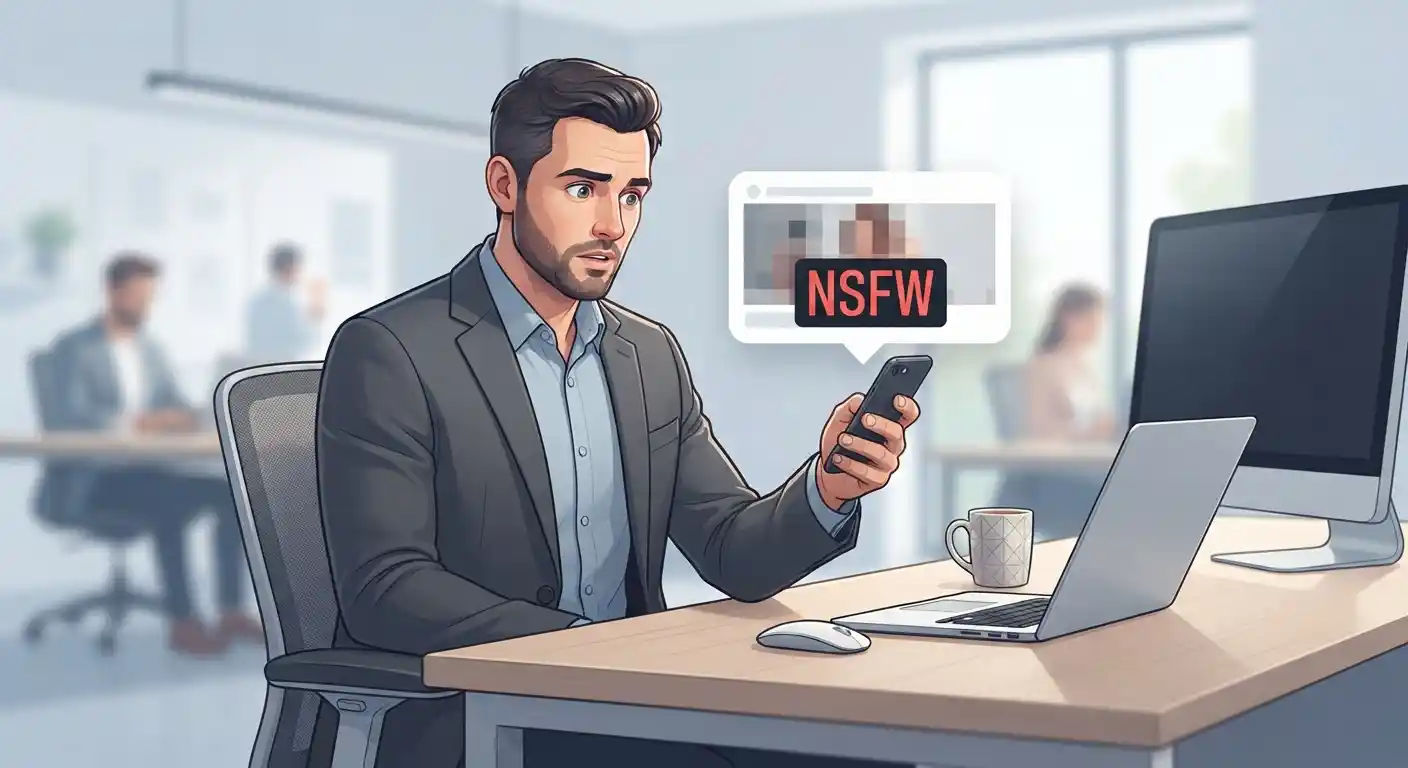
NSFW in text means “Not Safe For Work.” It is an internet abbreviation used as a warning that a photo, video, link, message, or other content may be inappropriate to view at work or in public.
Key Takeaways
- NSFW stands for Not Safe For Work.
- It is an internet acronym and content-warning label, not ordinary texting shorthand.
- NSFW can refer to sexual or adult material, nudity, graphic violence, offensive language, or other content that may be inappropriate in a public or professional setting.
- You may see it in texts, DMs, emails, forums, social media posts, links, images, and videos.
- The meaning usually stays the same across platforms, although the exact type of content being warned about depends on context.
- NSFW does not automatically indicate flirting or sexual interest when someone uses it in a conversation.
NSFW Meaning in Text
In texting, NSFW means “Not Safe For Work.” It is used to alert someone that the content they are about to open may not be suitable for viewing around coworkers, family, classmates, or other people nearby.
NSFW is best understood as a content warning rather than a reaction or emotion. Someone might write “NSFW” before sending a link, image, video, meme, or screenshot so the recipient can decide when and where to open it.
The term is commonly associated with adult or sexual material, but it can also describe graphic violence, disturbing imagery, offensive language, or other material that could be inappropriate in a workplace or public environment.
What Type of Term Is NSFW?
NSFW is an acronym because each letter represents part of the phrase:
- N = Not
- S = Safe
- F = For
- W = Work
It is also commonly described as internet slang or an online content-warning abbreviation.
What Does NSFW Stand For?
NSFW stands for “Not Safe For Work.” Another wording you may encounter is “Not Suitable For Work,” which carries essentially the same warning. Major English dictionaries recognize both forms.
The original idea is simple: this is something you probably should not open where other people, especially coworkers, can see your screen.
Today, “work” is often interpreted more broadly. An NSFW warning can be useful anywhere content might be inappropriate or embarrassing to view publicly.
How Is NSFW Used?
NSFW usually appears before or alongside content rather than functioning as a normal word in a sentence.
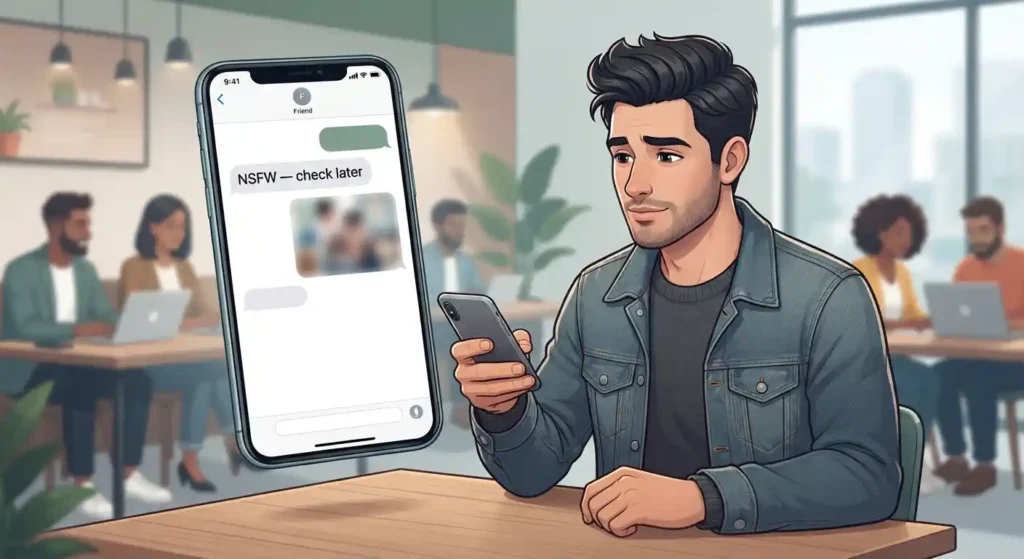
Text Messages
A friend might send:
“NSFW, save this for later.”
This means the friend is warning you that the attached content may not be appropriate to open immediately.
DMs
People may use NSFW before sending an image, video, meme, or link that contains mature or otherwise inappropriate material.
Group Chats
An NSFW label can give everyone in a group chat a chance to avoid opening something while they are at work, school, or around family.
Social Media
NSFW can appear in posts, captions, comments, content labels, or descriptions to warn viewers about potentially inappropriate material.
Online Forums
The abbreviation is especially useful around links, images, videos, or discussions that could be unsuitable for public viewing. Dictionaries specifically document its use with internet material, emails, and online forums.
Emails
Someone may place “NSFW” in a subject line or before a link or attachment as a warning that the material may not be appropriate to open in a professional environment.
NSFW in Different Contexts
The basic meaning does not normally change based on who sends it. Context determines what kind of content the warning refers to.
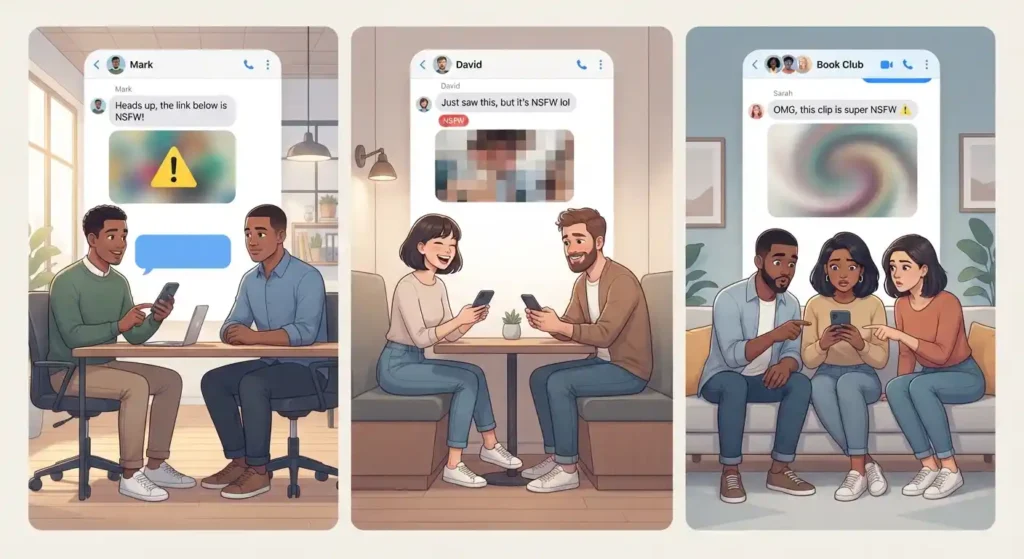
From a Friend
If a friend sends “NSFW” before a link, they are usually giving you a heads-up about the content.
From a Guy or Girl
The abbreviation itself does not have a different meaning depending on whether a guy or girl sends it. Look at the surrounding conversation to understand what the person means.
From a Crush
If a crush sends “NSFW,” the label alone does not prove romantic or sexual interest. The meaning depends on the content and the conversation around it.
In Dating
NSFW can refer to mature or sexual content in a dating conversation, but it can also simply be a warning about something graphic or inappropriate.
In a Relationship
Partners may use NSFW casually when sharing mature memes, photos, jokes, or other content. The abbreviation itself does not establish the sender’s intention.
In a Group Chat
The warning becomes especially useful when several people may be viewing the conversation in different settings.
In Social Media Comments
NSFW can warn other users before they click on or view material that may be unsuitable for public viewing.
Real Chat Examples
Here are realistic ways NSFW may appear in online conversations:
- Friend: “NSFW btw, don’t open that during your meeting.”
- You: “Thanks for the warning. I’ll check it later.”
- Friend: “I found the video you were talking about. NSFW.”
- You: “Got it. I’ll wait until I’m somewhere private.”
- Friend: “This meme is hilarious but definitely NSFW.”
- You: “LOL, sending it to me with a warning was smart.”
- Friend: “NSFW link below.”
- You: “Noted. I’ll open it later.”
- Friend: “That picture is NSFW, just so you know.”
- You: “Appreciate the heads-up.”
- Friend: “Don’t click this at work. NSFW.”
- You: “Good call. I’m at my desk right now.”
- Friend: “NSFW warning before you watch this.”
- You: “I’ll save it for when I’m home.”
- Friend: “Posting this here with an NSFW warning.”
- You: “Thanks for labeling it.”
- Friend: “This thread gets pretty NSFW.”
- You: “I’ll keep that in mind.”
- Friend: “NSFW content ahead.”
- You: “Okay, I’ll skip it for now.”
How to Reply to NSFW
Your response depends on whether you want to view the content and what your relationship with the sender is.
Casual Replies
- “Got it.”
- “Thanks for the warning.”
- “I’ll check it later.”
- “Noted.”
- “I’ll save it for later.”
Friendly Replies
- “Appreciate the heads-up.”
- “Good looking out.”
- “Thanks for warning me.”
- “I’ll wait until I’m somewhere private.”
Funny Replies
- “My workplace thanks you.”
- “Glad you warned me first.”
- “Definitely not opening that in the office.”
- “That warning probably saved my job.”
Neutral Replies
- “Understood.”
- “Thanks for letting me know.”
- “I’ll avoid opening it right now.”
- “Okay, I’ll view it later.”
Flirty/Relationship Replies
If the surrounding conversation is already romantic and the content is appropriate for that relationship, a playful response might be:
- “Now I’m curious.”
- “I’ll check it when I have some privacy.”
- “You definitely knew what you were doing with that warning.”
The word NSFW itself does not prove that the conversation is romantic or sexual.
What Tone Does NSFW Have?
NSFW generally has a neutral, direct, and informal tone. Its main purpose is to warn someone before they view potentially inappropriate content.
Depending on the conversation, it can also feel:
- Casual
- Playful
- Matter-of-fact
- Humorous
- Cautionary
- Context-dependent
For example, “NSFW” before a serious warning is straightforward, while “NSFW 😂” may be used playfully. The abbreviation itself does not automatically make a message flirtatious.
Is NSFW Rude or Offensive?
NSFW is not inherently rude or offensive. It is primarily a warning label.
It is generally suitable for casual online communication, especially when talking about potentially inappropriate digital content. However, it is less appropriate for formal writing when a clearer description would be more professional.
For workplace communication, the content itself matters more than the abbreviation. If something may violate workplace rules or make others uncomfortable, simply labeling it NSFW does not make it appropriate to share.
Other Meanings of NSFW
The dominant meaning of NSFW in internet communication is “Not Safe For Work.” Dictionaries also recognize “Not Suitable For Work” as a variant.
You may occasionally encounter other expansions of the letters in acronym databases or as jokes, but these are not the standard interpretation of NSFW in texting and online communication.
NSFW as a Title or Name
NSFW can also appear as part of the title of a song, album, show, publication, or other named work. Those uses are separate from the texting abbreviation and require context to identify correctly.
Common Mistakes About NSFW
Assuming NSFW Always Means Sexual Content
Sexual or adult material is a common reason for an NSFW warning, but it is not the only one. Graphic violence, disturbing imagery, offensive language, and other inappropriate material can also receive an NSFW label.
Assuming NSFW Means Flirting
If someone sends you “NSFW,” that does not automatically mean they are flirting with you. Check what they sent and what you were discussing.
Treating NSFW Like a Normal Reaction
NSFW is usually a warning label, not an emotional response like “LOL,” “OMG,” or “SMH.”
Thinking the Meaning Changes With Gender
Whether the sender is a guy, girl, friend, partner, or stranger does not fundamentally change what NSFW stands for.
Assuming “Work” Only Means an Office
The warning can be relevant in other public or shared environments, such as school, public transportation, or around family. The core idea is that the content may not be suitable for the setting.
NSFW and Related Slang
| Term | Meaning | Common Use |
|---|---|---|
| NSFW | Not Safe For Work | Warning about potentially inappropriate content |
| SFW | Safe For Work | Indicates content is generally suitable for workplace or public viewing |
| NSFL | Not Safe For Life | Stronger warning for extremely disturbing or graphic material |
NSFW and SFW are opposites in many online contexts, while NSFL generally signals content that is considerably more disturbing than ordinary NSFW material.
People Also Ask About NSFW Meaning in Text
What does NSFW mean in texting?
NSFW means “Not Safe For Work.” In texting, it warns that a message, image, video, link, or other content may not be appropriate to view in a workplace or public setting.
Does NSFW always mean something sexual?
No. NSFW is often associated with sexual or adult material, but it can also warn about graphic violence, disturbing images, offensive language, or other mature content.
Is NSFW a slang word or an acronym?
NSFW is an acronym made from the first letters of “Not Safe For Work.” It is also widely used as internet slang and a content-warning label.
What does NSFW mean on social media?
On social media, NSFW usually warns users that a post, image, video, link, or discussion may be inappropriate for viewing in public or professional settings.
Does NSFW mean not safe for kids?
Not necessarily. NSFW is specifically a warning that content may be inappropriate for work or public viewing. Depending on the material, it may also be unsuitable for children, but that is not what the abbreviation literally means.
Is NSFW appropriate to use at work?
The abbreviation itself is not offensive, but content labeled NSFW may be inappropriate to view or share at work. A warning does not make inappropriate workplace content acceptable.
What is the opposite of NSFW?
SFW, meaning “Safe For Work,” is commonly used as the opposite of NSFW. It indicates that content is generally suitable for viewing in a workplace or other public setting.
Does NSFW mean the person is flirting?
No. NSFW does not automatically indicate flirting, attraction, or sexual interest. The surrounding conversation and the content being shared provide the relevant context.
Conclusion
NSFW means “Not Safe For Work” and is an internet acronym used to warn people about content that may be inappropriate to view in a workplace, public setting, or around others. It can refer to adult material, graphic content, offensive language, or other potentially unsuitable media.
In texting and social media, NSFW is usually a neutral content warning. Its meaning does not automatically change based on whether it comes from a friend, crush, partner, guy, or girl. Context tells you what the warning refers to and whether any additional meaning is intended.

Writing puns and jokes for three and a half years has given Grace Collins experience working with language across varied subjects. As a writer, she covers food, animals, seasonal themes, technology, entertainment, and trending topics. Grace gathers subject-specific terms, explores word associations, and polishes joke structures to improve phrasing, punchlines, and comedic timing.