Sexual slang refers to informal words, phrases, abbreviations, and expressions used to talk about sex, sexual attraction, body parts, dating, or intimate topics. In texting and online communication, the meaning and tone depend heavily on context.
Key Takeaways
- Sexual slang is informal language connected with sex, sexuality, attraction, dating, or intimate subjects.
- It is not one specific word or acronym; it describes a broad category of slang.
- Some terms are playful or euphemistic, while others are vulgar, explicit, or offensive.
- Text messages, DMs, dating apps, group chats, and social media can use sexual slang differently.
- Context matters when interpreting a sexual slang term, especially when the same word has a non-sexual meaning.
- Professional, school, and formal communication generally calls for clearer and more appropriate language.
Sexual Slang Meaning in Text
In text messages, sexual slang means informal language used to discuss or hint at sexual topics. It can include shortened expressions, coded wording, euphemisms, jokes, and terms associated with dating or sexual relationships.
Unlike a traditional texting abbreviation, sexual slang is a broad language category rather than a single fixed expression. Some terms directly refer to sexual subjects, while others use humor, metaphor, or indirect wording.
The tone can range from casual and playful to vulgar or explicitly sexual. A person’s relationship with the recipient and the surrounding conversation can change how a term should be understood.
What Does Sexual Slang Stand For?
Sexual slang does not have a traditional full form. It is a descriptive phrase for informal words and expressions associated with sexuality.
The word sexual relates to sex or sexuality, while slang refers to informal vocabulary used in particular social groups or settings. Together, the phrase describes informal sexual language.
It should not be confused with a texting acronym such as DTF, ONS, or GGG. Those are individual expressions that can fall within the wider category of sexual or dating slang.
How Is Sexual Slang Used?
Sexual slang can appear in several forms of online communication:

- Text messages: People may use abbreviations, euphemisms, or playful wording.
- DMs: Dating or intimate conversations may contain more direct slang.
- Group chats: Friends may use sexual jokes or slang for humor.
- Social media: Euphemisms and altered spellings can appear in posts, comments, or captions.
- Dating profiles: Some abbreviations describe relationship or intimacy preferences.
- Online communities: Different communities can develop their own terminology.
Not every use is intended seriously. A slang expression can be used as a joke, reference, euphemism, or direct statement depending on the conversation.
Sexual Slang in Different Contexts
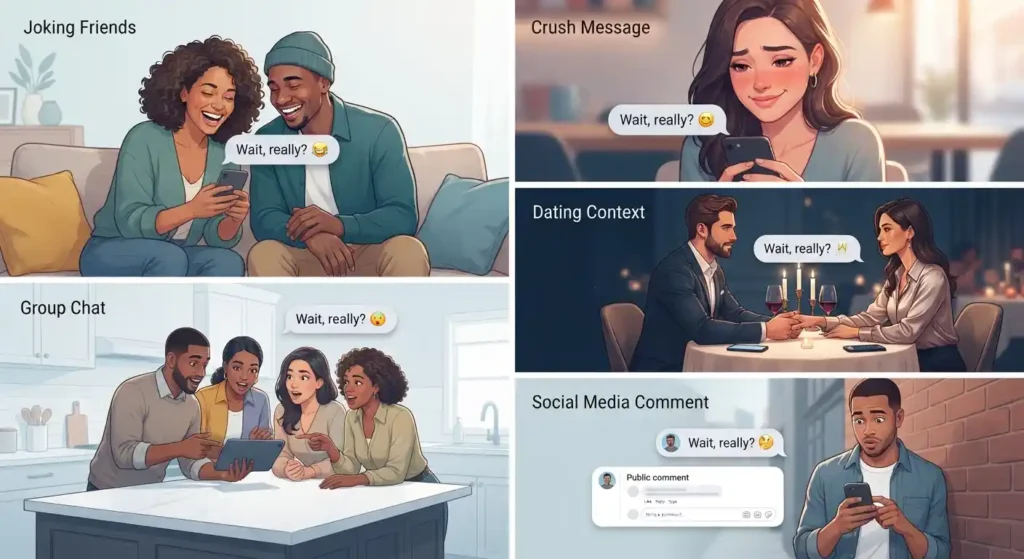
The same expression can communicate different things depending on who uses it and why.
From a Friend
Friends may use sexual slang as humor, teasing, or casual conversation. That does not automatically mean the message contains romantic or sexual interest.
From a Guy
A sexual term from a guy could be a joke, a direct comment, flirting, or simply part of an existing conversation. The wording around it matters more than gender alone.
From a Girl
The same principle applies when a girl uses sexual slang. Gender does not automatically change the definition or prove romantic intent.
From a Crush
A sexual slang term from a crush may feel more suggestive because of the existing relationship, but the term itself does not prove attraction.
In Dating
Dating conversations commonly use shorthand related to attraction, hookups, relationship status, boundaries, or sexual compatibility. The exact meaning should be interpreted from the complete conversation.
In a Relationship
Partners may use sexual slang casually or playfully, but the meaning still depends on their established communication style.
In a Group Chat
Group chats can make sexual slang more humorous or indirect because several people are participating. A phrase that sounds suggestive in a private message may simply be a joke among friends.
In Social Media Comments
Public comments often use euphemisms, coded language, or jokes. A sexual-looking phrase may also be referencing a meme or trend rather than expressing genuine interest.
Real Chat Examples
Here are examples showing how sexual slang can appear in ordinary online conversations without assuming romantic intent:
- “What does that slang mean?” — Asking for clarification.
- “I keep seeing that term on dating apps.” — Discussing online dating vocabulary.
- “That comment sounded pretty suggestive.” — Describing the tone.
- “Is that actually sexual slang?” — Checking the meaning.
- “I thought it meant something completely different.” — Noticing an alternative meaning.
- “Can you explain that abbreviation?” — Asking about texting shorthand.
- “That word is pretty vulgar.” — Commenting on appropriateness.
- “I wouldn’t use that at work.” — Discussing context.
- “My friend used it as a joke.” — Describing casual use.
- “Does that phrase always mean something sexual?” — Checking context.
- “I saw it in a dating profile.” — Identifying where it appeared.
- “The surrounding message makes the meaning clearer.” — Using context.
- “Could that have a non-sexual meaning?” — Considering ambiguity.
- “I’m not sure how to respond to that.” — Asking for a reply.
- “That sounds flirty, but I don’t want to assume.” — Avoiding overinterpretation.
- “Is there a more neutral way to say this?” — Looking for appropriate wording.
- “I only know the slang version.” — Distinguishing slang from formal language.
- “That abbreviation can mean different things.” — Recognizing ambiguity.
How to Reply to Sexual Slang
Your response can depend on whether you understand the term and whether you are comfortable with the conversation.
Casual Replies
- “What do you mean by that?”
- “I know what you’re saying.”
- “Got it.”
- “That’s a new one for me.”
Friendly Replies
- “Haha, I didn’t expect that.”
- “Okay, I see where you’re going with this.”
- “You really had to phrase it that way?”
Funny Replies
- “Well, that escalated quickly.”
- “And here I thought we were having a normal conversation.”
- “That’s certainly one way to say it.”
Neutral Replies
- “Can you clarify what you mean?”
- “I’m not sure how you meant that.”
- “I’d rather keep the conversation less explicit.”
Flirty/Relationship Replies
If the conversation is already mutual and comfortable, a person might respond with:
- “Are you flirting with me?”
- “Is that supposed to be a hint?”
- “You’re being pretty bold today.”
- “What exactly are you suggesting?”
A sexual slang term by itself should not be treated as proof of attraction or consent.
What Tone Does Sexual Slang Have?
Sexual slang can have several tones:
- Casual: Used between people who are comfortable discussing intimate topics.
- Playful: Used as humor or teasing.
- Suggestive: Hints at sexual or romantic subjects without stating them directly.
- Direct: Clearly communicates an intimate topic.
- Vulgar: Uses language that may be considered crude or offensive.
- Neutral: Some terms can simply describe a topic without being intended as flirting.
- Context-dependent: The same expression can sound very different depending on the conversation.
Is Sexual Slang Rude or Offensive?
Some sexual slang is relatively mild, while other expressions are vulgar, explicit, insulting, or inappropriate for certain settings.
It may be acceptable between close friends or consenting adults who are comfortable with that style of communication. The same wording may be inappropriate in a workplace, classroom, professional email, formal document, or conversation with someone who has not indicated that such language is welcome.
When discussing sexual health, education, or medical subjects, precise terminology is usually clearer than slang.
Other Meanings of Sexual Slang
Sexual slang itself does not have a major alternative acronym expansion. However, individual terms categorized as sexual slang can have completely different meanings in other contexts.
When Context Changes the Meaning
Some words that appear in sexual conversations also have ordinary meanings. For example, “cum” can function as a Latin-derived combining word meaning “with” or “combined with” in formal compounds, while in sexual slang it has a different meaning.
This is why surrounding words are important before interpreting an unfamiliar term.
Numbers and Symbols
Some sexual slang uses numbers or symbols rather than ordinary words. “69,” for example, has a recognized sexual slang meaning, although numbers can obviously have ordinary meanings in other contexts.
Online Euphemisms
Some online communities use altered spellings or euphemisms to discuss sexual subjects indirectly. “Seggs,” for example, is an online euphemistic spelling of “sex.”
Common Mistakes About Sexual Slang
Assuming One Meaning Fits Every Situation
A slang term may have multiple meanings. Look at the surrounding sentence and conversation before deciding what someone intended.
Assuming Slang Proves Flirting
A sexual expression can be a joke, quotation, meme reference, or casual comment. It does not automatically prove attraction.
Ignoring the Relationship
A phrase from a close partner can have a different tone from the same phrase posted publicly or sent by a stranger.
Treating Every Abbreviation as Sexual
Some abbreviations have unrelated meanings in technology, business, gaming, or everyday conversation. Context is essential.
Using Slang in Formal Communication
Even when you understand a term, that does not mean it belongs in professional or academic writing. More precise language is usually safer in formal settings.
Sexual Slang and Related Slang
| Term | Meaning | Common Use |
|---|---|---|
| DTF | An abbreviation expressing willingness for casual sex | Dating and texting |
| ONS | One-night stand | Dating and relationship conversations |
| GGG | “Good, giving, and game” | Dating profiles and sexual compatibility discussions |
| Seggs | Euphemistic spelling of “sex” | Social media and online conversation |
| 69 | A sexual reference using a number | Texting, jokes, and online slang |
| XXX | A label associated with explicit or pornographic content | Adult-content contexts |
DTF is commonly used as sexual/dating shorthand, while GGG refers to a particular approach to sexual compatibility.
People Also Ask About Sexual Slang
What is sexual slang?
Sexual slang is informal language used to discuss or refer to sex, sexuality, attraction, intimate relationships, or related subjects. It can include words, phrases, abbreviations, euphemisms, and coded expressions.
Is sexual slang the same as sexting?
No. Sexual slang is a type of vocabulary, while sexting refers to sending sexually suggestive or explicit messages or media electronically. Someone can use sexual slang without sexting.
Why do people use sexual slang?
People may use it for humor, privacy, indirect communication, cultural expression, flirting, or because informal language feels less clinical than formal terminology. The reason depends on the speaker and situation.
Can sexual slang have more than one meaning?
Yes. Some expressions have both sexual and non-sexual meanings. Context, surrounding words, punctuation, emojis, and the relationship between speakers can help determine the intended meaning.
Is sexual slang appropriate at work?
Generally, sexual slang is a poor choice for professional communication because some terms are vulgar, explicit, or easily misunderstood. Formal or neutral wording is usually more appropriate.
Does sexual slang always mean someone is flirting?
No. Sexual slang can be used jokingly, descriptively, sarcastically, or casually. A single slang term is not enough to establish romantic or sexual intent.
What is “seggs” slang for?
“Seggs” is an altered spelling of “sex” used online as a euphemism. It is associated with social-media and internet communication.
Why can sexual slang be confusing?
Sexual slang changes across communities and online spaces, and some terms have multiple meanings. A word that seems sexual in one conversation can have an ordinary meaning somewhere else.
Conclusion
Sexual slang is a broad category of informal language connected with sex, sexuality, attraction, dating, and intimate subjects. It has no single full form because it describes many different words, phrases, abbreviations, and euphemisms.
Its meaning and tone depend on context. Some expressions are playful or indirect, while others are vulgar or explicit. Understanding the surrounding conversation is important, especially when a term could have another meaning. For professional, academic, or formal communication, clearer and more neutral language is usually the better choice.

Mila Parker brings three years of writing experience to the craft of puns, jokes, and concise wordplay. Her subject range moves through food, animals, seasonal themes, technology, entertainment, and trending topics. She studies relevant terminology, connects words through double meanings and associations, then adjusts setups and punchlines to keep each joke clear and well structured.