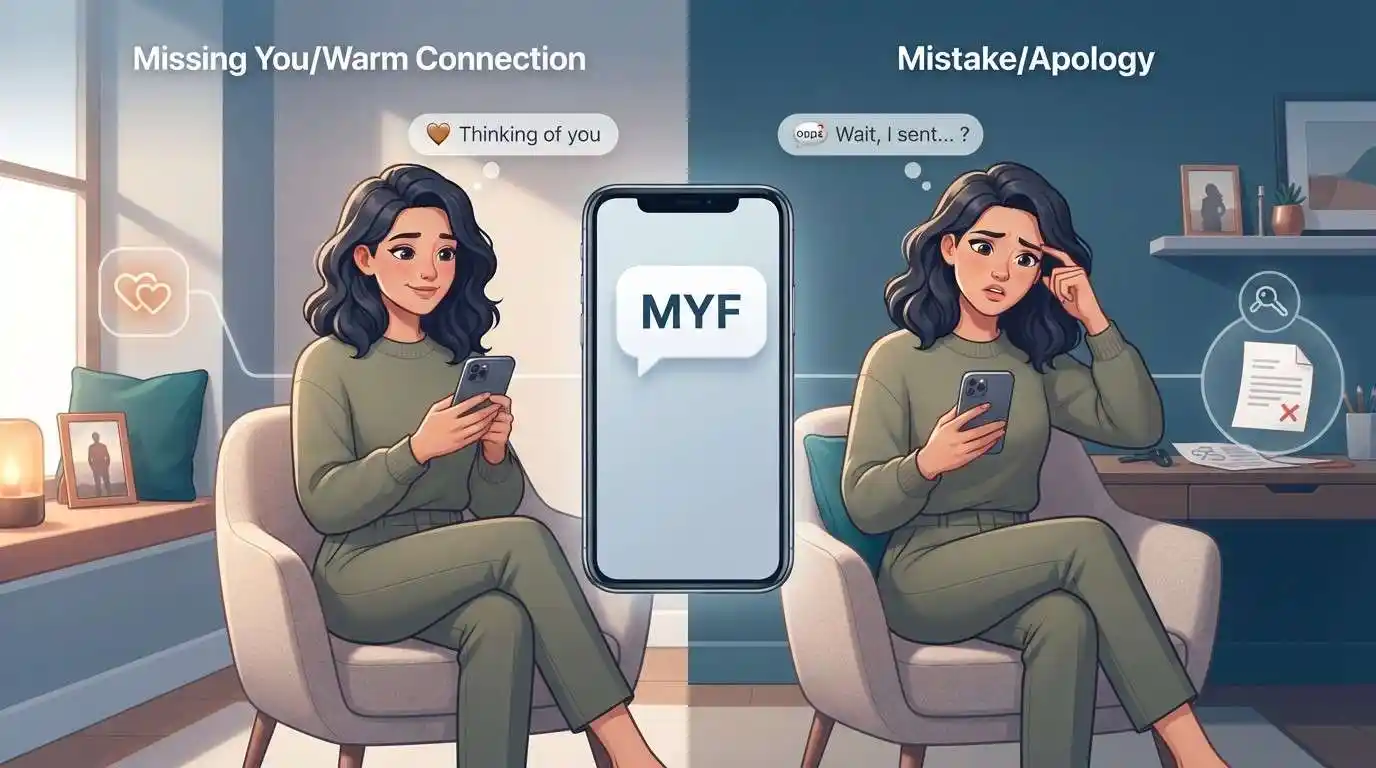
MYF does not have one fixed meaning in text. Depending on the conversation, it can mean “Miss Your Face” or “My Fault.” The surrounding message, tone, and situation usually reveal which meaning the sender intended.
Key Takeaways
- MYF can mean “Miss Your Face” in affectionate or friendly conversations.
- MYF can also mean “My Fault” when someone admits a mistake.
- It is an informal texting abbreviation, not a standard English word.
- Context matters because the two main meanings have very different tones.
- MYF may appear in texts, DMs, social media conversations, and other casual online chats.
- If the message is unclear, the safest approach is to ask what the sender means.
MYF Meaning in Text
In texting, MYF is a context-dependent abbreviation with two well-documented uses: “Miss Your Face” and “My Fault.” The first is affectionate and usually relates to missing someone’s presence, while the second is a casual way to accept responsibility for a mistake.
As “Miss Your Face,” MYF expresses that someone misses seeing or spending time with another person. It can be warm, playful, affectionate, or slightly flirty depending on the relationship.
As “My Fault,” MYF works like “my bad” or “that was my mistake.” It normally appears after someone forgets something, makes an error, or realizes they caused a problem.
MYF is best understood as text slang, messaging shorthand, or an internet abbreviation rather than a formal acronym used in professional writing.
What Does MYF Stand For?
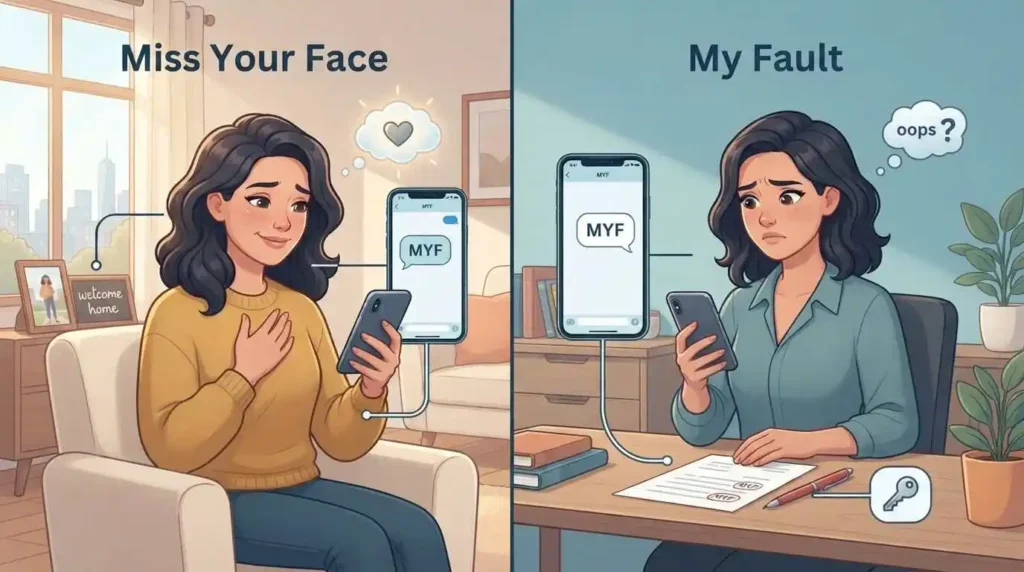
MYF can stand for:
MYF = Miss Your Face
This meaning is used when someone wants to say they miss seeing another person.
MYF = My Fault
This meaning is used when someone admits responsibility for a mistake.
The important point is that MYF does not have one universally accepted expansion in texting. Different communities and individual texters can use the same letters differently, so the words surrounding MYF are more useful than the abbreviation alone.
How Is MYF Used?
MYF can appear in casual digital communication, including:
- Text messages
- Private messages
- Group chats
- Social media comments
- Casual online conversations
The meaning changes according to the sentence.
For example:
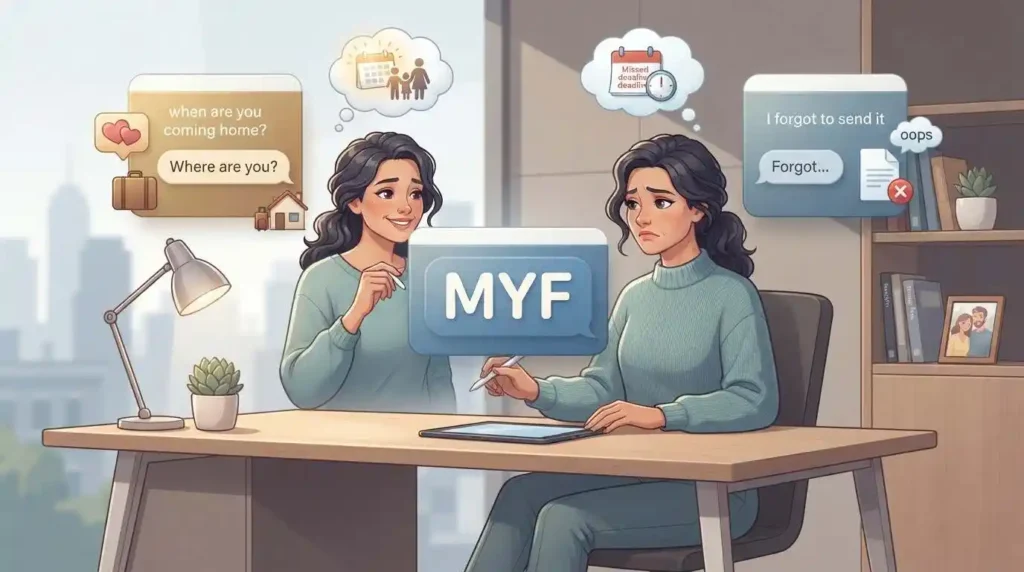
“MYF, when are you coming home?”
Here, MYF likely means “Miss Your Face.”
But:
“MYF, I forgot to send it.”
Here, MYF means “My Fault.”
The same three letters can therefore communicate affection in one message and an apology in another.
MYF in Different Contexts
From a Friend
If a friend writes:
“MYF! We haven’t hung out in forever.”
The likely meaning is “Miss Your Face.” The message expresses that they miss seeing you.
If they write:
“MYF, I forgot your birthday.”
The meaning is probably “My Fault.”
From a Guy
MYF does not automatically become romantic when a guy sends it.
If he writes:
“MYF, we need to hang out soon.”
it could simply mean “Miss Your Face.” Whether there is romantic interest depends on the broader relationship and conversation, not the abbreviation alone.
From a Girl
The same rule applies when a girl uses MYF. The letters themselves do not create a different gender-specific meaning.
From a Crush
If a crush sends:
“MYF ❤️”
the affectionate context may suggest “Miss Your Face.” However, MYF alone cannot prove romantic attraction.
In Dating
In dating conversations, “Miss Your Face” can sound affectionate or flirty.
For example:
“Had such a good time yesterday. MYF already.”
That sounds warmer than a neutral statement such as “See you later.”
Still, the relationship and previous conversation provide the real context.
In a Group Chat
In a group chat, MYF may be harder to interpret because the sender could be addressing one person or admitting responsibility for something.
“MYF guys, wrong address.”
Here, “My Fault” is the natural reading.
In Social Media Comments
When MYF appears under someone’s photo, throwback, or personal post, “Miss Your Face” can make sense.
For example:
“That throwback 😭 MYF!”
The surrounding content suggests the sender is expressing that they miss the person.
Real Chat Examples
Here are realistic examples showing the two main meanings:
1. Missing a friend
Alex: “MYF. We need our coffee dates back.”
Meaning: Miss Your Face.
2. Admitting a mistake
Alex: “MYF, I sent the wrong file.”
Meaning: My Fault.
3. Missing someone after a trip
Sam: “Home already and MYF 😭”
Meaning: Miss Your Face.
4. Forgetting plans
Sam: “MYF, I completely forgot we had plans.”
Meaning: My Fault.
5. Talking to a close friend
“MYF! Come visit soon.”
Meaning: Miss Your Face.
6. Correcting a mistake
“MYF, I thought the meeting was tomorrow.”
Meaning: My Fault.
7. After seeing an old photo
“Just found this pic from college. MYF.”
Meaning: Miss Your Face.
8. Sending the wrong message
“Oops MYF, that was meant for someone else.”
Meaning: My Fault.
9. Missing someone’s company
“The party wasn’t the same without you. MYF.”
Meaning: Miss Your Face.
10. Taking responsibility
“MYF for the late reply.”
Meaning: My Fault.
11. Reconnecting
“Long time no see. MYF!”
Meaning: Miss Your Face.
12. Forgetting an item
“MYF, I left your charger at home.”
Meaning: My Fault.
13. Affectionate message
“MYF already and you just left 😂”
Meaning: Miss Your Face.
14. Small apology
“MYF, I didn’t read your whole message.”
Meaning: My Fault.
15. Planning a meetup
“MYF! When are we getting together again?”
Meaning: Miss Your Face.
16. Group mistake
“MYF everyone, I gave you the old address.”
Meaning: My Fault.
17. Friendly social comment
“MYF, girl! We need another weekend together.”
Meaning: Miss Your Face.
18. Missed call
“MYF, I was driving and couldn’t answer.”
Meaning: My Fault.
19. After a vacation
“Back home now. MYF!”
Meaning: Miss Your Face.
20. Owning an error
“MYF, I completely misunderstood what you said.”
Meaning: My Fault.
How to Reply to MYF
Your reply should depend on which meaning the sender intended.
Casual Replies
If MYF means “Miss Your Face”:
- “MYF too!”
- “Same here.”
- “I know, it’s been too long.”
- “We definitely need to hang out.”
- “Come see me soon.”
If it means “My Fault”:
- “No worries.”
- “All good.”
- “It happens.”
- “You’re good.”
- “No problem.”
Friendly Replies
For “Miss Your Face”:
- “Miss you too!”
- “We need to catch up soon.”
- “I was just thinking about you.”
- “Same, it’s been forever.”
For “My Fault”:
- “You’re fine.”
- “Don’t worry about it.”
- “No big deal.”
- “We’re good.”
Funny Replies
If someone says “MYF” meaning “Miss Your Face”:
- “My face misses you too 😂”
- “Then come see it 😂”
- “Proof you have good taste.”
If they mean “My Fault”:
- “Apology accepted 😂”
- “I’ll allow it.”
- “Case closed.”
Neutral Replies
If you are unsure what MYF means:
- “Wait, what do you mean by MYF?”
- “MYF as in ‘my fault’?”
- “Do you mean ‘miss your face’?”
- “Just checking what you meant.”
Asking is better than confidently responding to the wrong meaning.
Flirty/Relationship Replies
If MYF clearly means “Miss Your Face” and the conversation is already romantic, you could reply:
- “Miss yours too ❤️”
- “Then when am I seeing you?”
- “I was hoping you’d say that.”
- “Come fix that soon.”
MYF by itself does not establish that the sender is flirting. The rest of the conversation matters.
What Tone Does MYF Have?
MYF can have very different tones depending on the expansion.
| Meaning | Typical Tone |
|---|---|
| Miss Your Face | Friendly, affectionate, playful |
| My Fault | Casual, apologetic, direct |
When “Miss Your Face” is intended, the message often feels personal and warm.
When “My Fault” is intended, it usually has a practical, low-key tone similar to “my bad.” Sources documenting the abbreviation show both uses, which is why interpreting the surrounding sentence is important.
Is MYF Rude or Offensive?
MYF is not inherently rude or offensive. The meaning determines how it comes across.
“Miss Your Face” is generally affectionate or friendly.
“My Fault” is normally a casual acknowledgment of responsibility.
However, MYF is informal, so it is better suited to casual conversations than formal communication.
For friends and casual social media conversations, it can fit naturally.
For school, work, business emails, applications, or professional writing, spelling out the intended phrase is clearer.
If MYF appears in a professional message, it is especially important not to assume a slang meaning without checking the context.
Other Meanings of MYF
There are additional interpretations of MYF online, but they are not as reliable or broadly established as “Miss Your Face” and “My Fault.” Some slang-dictionary entries also record a more vulgar interpretation involving a phrase telling someone to mind their business.
Because those uses are context-specific, it is better not to assume a vulgar meaning unless the surrounding conversation clearly supports it.
Likewise, some websites list “My Friend” and other expansions, but these should not automatically be treated as the intended meaning in an ordinary text. The key distinction is between documented possibilities and the meaning actually intended by the sender.
Common Mistakes About MYF
Assuming MYF Always Means “Miss Your Face”
This is one of the easiest mistakes to make. If MYF appears after someone admits a mistake, “My Fault” is a much more natural interpretation.
Assuming MYF Always Means “My Fault”
The opposite can also happen. If someone says they miss seeing you, “Miss Your Face” makes much more sense.
Assuming It Is Automatically Flirty
“Miss Your Face” can be affectionate, but it does not automatically mean romantic interest.
Friends, relatives, partners, and other close people can use affectionate language.
Ignoring the Rest of the Message
Three letters rarely provide enough information by themselves.
Look at:
- The sentence before MYF
- The topic being discussed
- Emojis
- Punctuation
- Your relationship with the sender
- Whether someone just made a mistake
- Whether you were discussing seeing each other
Treating MYF Like Formal English
MYF is casual messaging shorthand. It should not normally replace clear language in professional or formal writing.
MYF and Related Slang
| Term | Meaning | Common Use |
|---|---|---|
| MYF | Miss Your Face / My Fault | Missing someone or admitting a mistake |
| MY BAD | My mistake | Casual apology |
| I MISS YOU | Expression of missing someone | Personal conversations |
| SORRY | Apology | Casual or formal situations |
| MISS U | Miss you | Informal texting |
| IDC | I don’t care | Casual online communication |
People Also Ask About MYF
Does MYF mean “Miss Your Face”?
Yes. “Miss Your Face” is a documented texting use of MYF, especially in affectionate or friendly conversations where someone is expressing that they miss seeing another person.
Does MYF mean “My Fault”?
Yes. “My Fault” is another documented texting meaning. It is generally used when someone acknowledges a mistake or accepts responsibility for something that went wrong.
Is MYF a slang word or abbreviation?
MYF is best described as informal messaging shorthand or an internet abbreviation. It is not a standard English word.
Is MYF flirty?
It can be slightly flirty when it means “Miss Your Face”, especially between people who are dating or interested in each other. But MYF alone does not prove romantic interest.
How can I tell whether MYF means “My Fault” or “Miss Your Face”?
Look at the surrounding message. If the person is discussing a mistake, MYF probably means “My Fault.” If they are talking about missing you, seeing you, or spending time together, “Miss Your Face” is more likely.
Is MYF appropriate at work?
Usually, it is better to avoid MYF in professional communication because the abbreviation is ambiguous. Writing “my fault” or “I miss seeing you” makes the intended meaning immediately clear.
What should I say if I don’t understand MYF?
Ask directly but casually: “Do you mean ‘my fault’ or ‘miss your face’?” That is often the easiest way to avoid misunderstanding the message.
Conclusion
MYF does not have one universal meaning in text. Its two important texting interpretations are “Miss Your Face” and “My Fault.” The first is friendly or affectionate, while the second is a casual way to admit a mistake. Context, relationship, wording, and the surrounding conversation determine which meaning applies.
Because MYF is informal and potentially ambiguous, it works best in casual messages rather than professional or formal writing. When the context is unclear, asking the sender what they meant is the safest choice.

Mila Parker brings three years of writing experience to the craft of puns, jokes, and concise wordplay. Her subject range moves through food, animals, seasonal themes, technology, entertainment, and trending topics. She studies relevant terminology, connects words through double meanings and associations, then adjusts setups and punchlines to keep each joke clear and well structured.