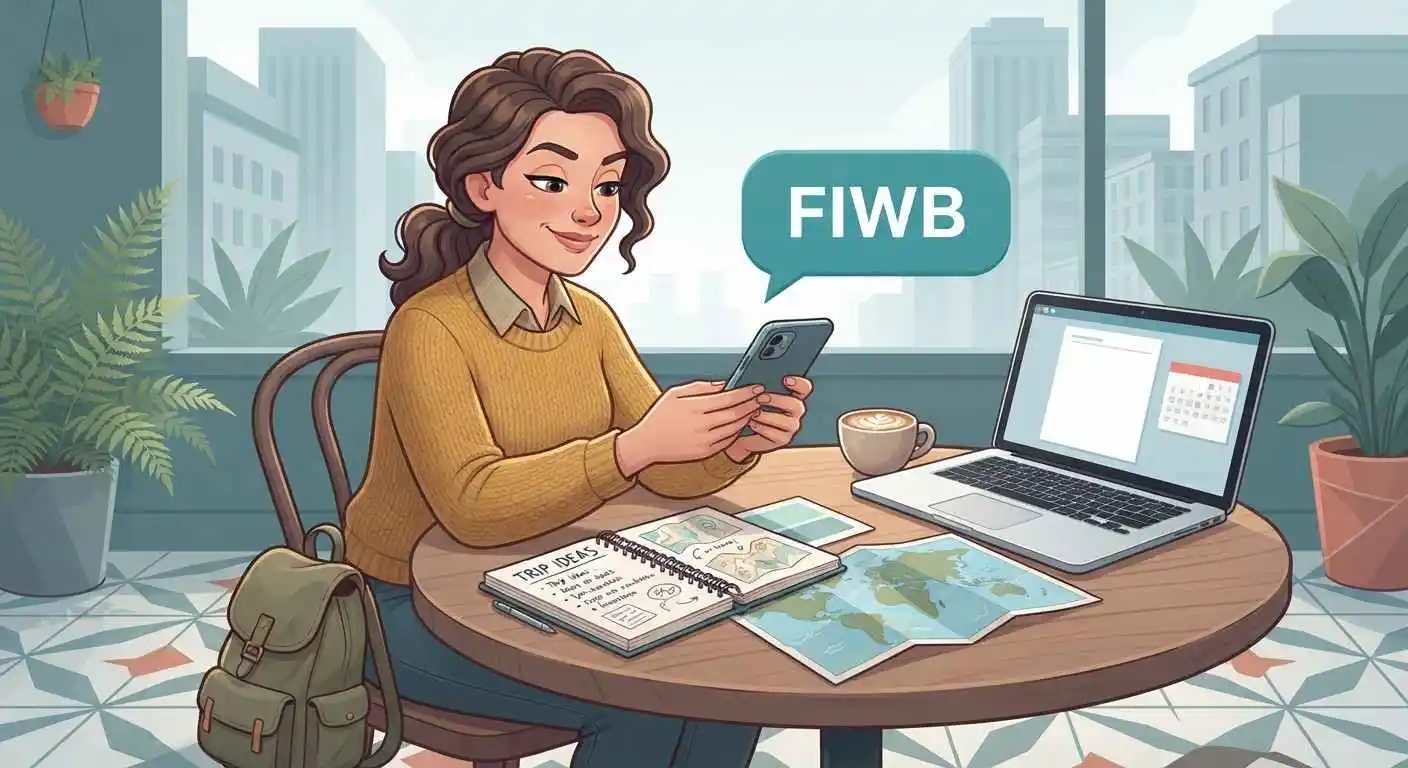
FIWB usually means “Fuck It, We Ball” in text and online slang. It expresses a carefree attitude of deciding to go ahead with something despite uncertainty, problems, or a lack of a perfect plan. It is informal and includes profanity.
Key Takeaways
- FIWB usually stands for “Fuck It, We Ball.”
- It means roughly “let’s just go for it” or “stop overthinking and do it anyway.”
- The phrase is commonly associated with internet slang, memes, casual chats, and online communities.
- FIWB is not inherently romantic or flirty when someone sends it to you.
- Because the full phrase contains profanity, it is best suited to casual communication rather than professional or formal writing.
- FIWB should not be confused with FWB, which commonly means “friends with benefits.”
FIWB Meaning in Text
In texting, FIWB means “Fuck It, We Ball.” It is a casual internet expression used when someone decides to move forward despite uncertainty, risk, disappointment, or imperfect circumstances.
In simpler words, FIWB can communicate:
- “Let’s just do it.”
- “Why overthink it?”
- “We’ll figure it out.”
- “Might as well go for it.”
- “Whatever happens, happens.”
The word “ball” is usually figurative in this expression. It does not necessarily mean playing basketball. Instead, it adds a humorous, confident, or carefree feeling to the decision.
FIWB is best understood as messaging shorthand or internet slang, rather than a formal abbreviation. Its meaning can also depend on the conversation around it.
What Does FIWB Stand For?
FIWB stands for “Fuck It, We Ball.”
The phrase is sometimes softened in writing as “F it, we ball” when someone wants to avoid spelling out the profanity.
The basic idea is to stop worrying about whether a situation is perfect and move forward anyway. For example:
“We haven’t planned the trip at all, but FIWB.”
Here, the person is jokingly saying that they are going ahead with the trip despite the lack of planning.
How Is FIWB Used?
FIWB is most natural in informal online communication. Someone might use it after describing a risky, spontaneous, frustrating, or uncertain situation.

Text Messages
A friend might say:
“I barely studied for this test. FIWB.”
The meaning is essentially, “I didn’t prepare enough, but I’m going to take the test and see what happens.”
DMs and Group Chats
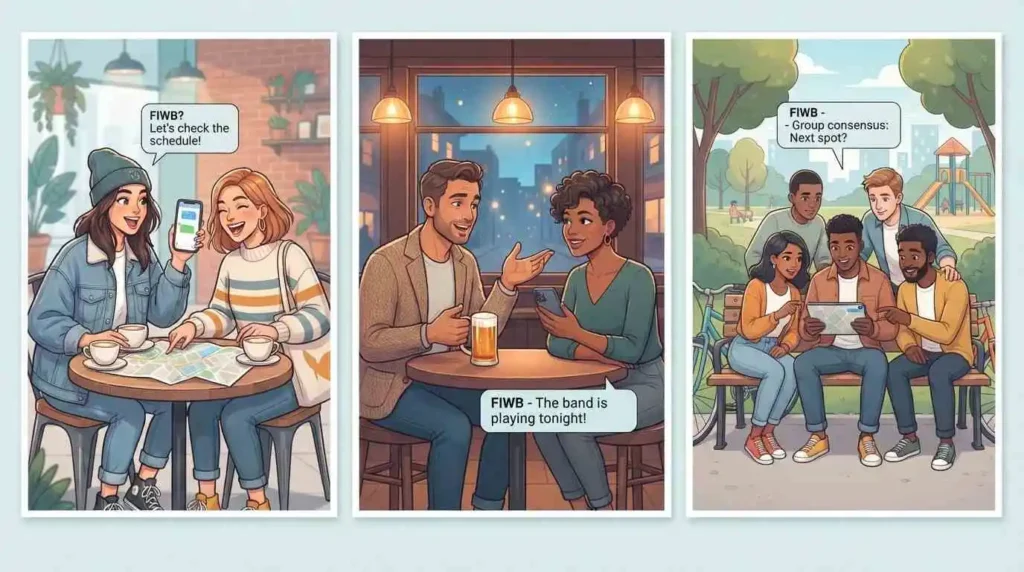
In a group conversation, FIWB can signal that someone has stopped debating and wants to move forward.
“Nobody can decide where we’re eating. FIWB, I’m picking the place.”
Social Media and Memes
FIWB also works as a short caption or reaction to situations involving spontaneous decisions, mistakes, setbacks, or humorous confidence.
Gaming
A player might use FIWB when their team has a difficult situation and decides to make an aggressive or unconventional move instead of playing cautiously.
The important point is that FIWB is casual internet language, so it generally fits relaxed conversations rather than formal communication.
FIWB in Different Contexts
The meaning stays fairly consistent, but the situation can change what the person is communicating.
From a Friend
If a friend texts:
“We don’t have a backup plan. FIWB.”
They probably mean they are willing to go ahead and deal with whatever happens.
From a Guy
FIWB does not automatically have a special meaning when a guy sends it. It generally carries the same “let’s just go for it” idea.
The surrounding conversation matters more than the sender’s gender.
From a Girl
Likewise, a girl using FIWB does not create a separate slang definition. She may simply be expressing a spontaneous or carefree attitude.
From a Crush
If your crush sends FIWB, the phrase alone does not prove flirting or romantic interest.
For example:
“Should we actually go to that concert tonight? FIWB.”
That could simply mean they are willing to make a spontaneous decision. The rest of the conversation provides the relevant context.
In Dating
FIWB can appear in a dating conversation when someone suggests taking a chance on plans or a spontaneous activity.
It does not inherently mean anything sexual or romantic.
In a Group Chat
In group chats, FIWB can function as a humorous way to end indecision:
“Nobody knows if this is a good idea. FIWB.”
The speaker is essentially saying, “Let’s do it anyway.”
In Social Media Comments
A person might comment FIWB under a post showing an unusual decision, unexpected outcome, or spontaneous activity. The comment usually conveys a playful “go for it” attitude.
Real Chat Examples
Here are realistic ways FIWB can appear in casual conversations:
- Alex: “Should we book the last-minute flight?”
Sam: “FIWB.” - Mia: “I haven’t finished decorating, but people are already coming.”
Jen: “FIWB 😂” - Chris: “Do we actually know where this trail goes?”
Drew: “Nope. FIWB.” - Taylor: “I could apply for the job, but I’m probably underqualified.”
Jordan: “FIWB. Apply anyway.” - Ben: “The recipe says bake for 25 minutes, but I forgot to set a timer.”
Kyle: “FIWB.” - Emma: “We have no idea what movie we’re watching.”
Lily: “FIWB, pick one.” - Jake: “Should I post this video? It’s not perfect.”
Ryan: “FIWB.” - Nina: “I don’t know if this outfit works.”
Sara: “FIWB. Wear it.” - Mike: “The game plan is falling apart.”
Chris: “FIWB, let’s improvise.” - Ava: “We forgot to make reservations.”
Maya: “FIWB. We’ll find somewhere.” - Dan: “I only have one attempt left.”
Leo: “FIWB.” - Rachel: “Should we actually go on this road trip tomorrow?”
Kayla: “FIWB 😂” - Noah: “I don’t know how this presentation is going to go.”
Eli: “FIWB. You’ve got this.” - Grace: “We have 20 minutes to finish this.”
Sophie: “FIWB, let’s move.” - Matt: “This plan might be terrible.”
Ryan: “Probably. FIWB.” - Olivia: “Should I send the message?”
Chloe: “If you want to, FIWB.” - Tyler: “We missed the first train.”
Josh: “FIWB, we’ll catch the next one.” - Liam: “I haven’t played this game before.”
Ethan: “FIWB, jump in.”
How to Reply to FIWB
Your response depends on what the other person means in the conversation.
Casual Replies
- “Honestly, fair.”
- “Let’s do it.”
- “Might as well.”
- “I’m in.”
- “Sounds good.”
Friendly Replies
- “That’s the spirit.”
- “Okay, let’s see what happens.”
- “I’m with you.”
- “You convinced me.”
- “Let’s roll.”
Funny Replies
- “This feels like a terrible plan 😂”
- “What could possibly go wrong?”
- “Absolutely no strategy, just vibes.”
- “I support the chaos.”
- “And we’re committing to it.”
Neutral Replies
- “What are you thinking?”
- “Okay, what’s the plan?”
- “I’m open to it.”
- “Let’s see how it goes.”
- “Sure, we can try.”
Flirty/Relationship Replies
If FIWB appears in a romantic conversation, you can match the playful energy without assuming that FIWB itself is flirting:
- “Then let’s make it a good decision 😉”
- “You really don’t need much convincing, huh?”
- “Okay, I’m down.”
- “Sounds like an adventure.”
- “Fine, let’s do it.”
What Tone Does FIWB Have?
FIWB is generally casual, playful, informal, and carefree.
Depending on the conversation, it can also sound:
- Bold
- Spontaneous
- Humorous
- Irreverent
- Self-deprecating
- Defiant
- Lighthearted
The tone often comes from the contrast between a difficult or uncertain situation and the person’s decision to move forward anyway.
For example:
“I have no idea what I’m doing. FIWB.”
This sounds humorous and carefree rather than genuinely serious or aggressive.
Is FIWB Rude or Offensive?
FIWB is informal and contains profanity, so it may be considered inappropriate in some settings.
It can work in:
- Casual texts
- Friend group chats
- Informal DMs
- Meme conversations
- Casual social media interactions
It is generally better to avoid it in:
- Professional emails
- Job applications
- Formal reports
- Academic assignments
- Workplace communication with people you do not know well
The softened version “F it, we ball” still carries the same informal tone because the underlying phrase contains profanity.
Other Meanings of FIWB
The meaning of FIWB depends on context.
In internet slang, “Fuck It, We Ball” is the important meaning when the term appears in casual texting or online conversation.
There are also non-slang uses of the same four letters. For example, FIWB can refer to “Family Income and Wealth Building” in a business or financial context. That meaning is not normally what someone intends when using FIWB casually in a text message.
FIWB can also appear as an acronym in specialized academic or professional contexts. Therefore, when the surrounding conversation is not about internet slang, context should be used before interpreting the abbreviation.
Common Mistakes About FIWB
Confusing FIWB With FWB
This is one of the most important distinctions.
FIWB commonly means “Fuck It, We Ball.”
FWB commonly means “friends with benefits.”
They are different expressions, even though the letter combinations look similar.
Assuming FIWB Means Basketball
The word “ball” can make the expression sound sports-related, but FIWB is usually used figuratively. The person is not necessarily talking about basketball.
Assuming It Is Flirty
FIWB does not inherently indicate attraction, flirting, or romantic interest. The surrounding conversation determines whether romance is involved.
Treating It as Formal Language
FIWB is internet slang and casual shorthand. It is not a good choice for formal writing.
Assuming It Always Means “Don’t Care”
FIWB can express a willingness to take a chance, but it does not necessarily mean that the person genuinely doesn’t care about the outcome. Often, it is a humorous way of accepting uncertainty.
FIWB and Related Slang
| Term | Meaning | Common Use |
|---|---|---|
| FIWB | Fuck It, We Ball | Going ahead despite uncertainty |
| YOLO | You Only Live Once | Taking a chance or enjoying the moment |
| Wing it | Improvise without much preparation | Handling an uncertain situation |
| F it | Forget it / “Fuck it” | Dismissing hesitation or deciding to proceed |
| FWB | Friends With Benefits | A relationship involving friendship and sexual activity |
YOLO can overlap because both can express taking a chance, but they are not exact synonyms. FIWB often has a more humorous, resigned, or meme-like feel.
People Also Ask About FIWB
What does FIWB mean in a text message?
FIWB usually means “Fuck It, We Ball.” It is used when someone decides to go ahead with something despite uncertainty, risk, or imperfect preparation.
What does FIWB mean on social media?
On social media, FIWB generally carries the same “Fuck It, We Ball” meaning. It can be used as a caption, comment, reaction, or meme-style expression for a spontaneous decision.
Is FIWB the same as FWB?
No. FIWB usually means “Fuck It, We Ball,” while FWB commonly means “friends with benefits.” The two abbreviations have different meanings.
Does FIWB mean “let’s do it”?
Often, yes. In casual conversation, FIWB can communicate the idea of “let’s just do it” or “let’s go for it” despite uncertainty.
Is FIWB a bad word?
The abbreviation itself is not a swear word written out, but its standard expansion contains profanity. Because of that, it is generally considered informal.
Does FIWB mean flirting?
Not by itself. FIWB does not inherently communicate romantic interest or flirting. You need to consider the rest of the conversation, the relationship between the people, and the surrounding wording.
Can I use FIWB at work?
It is safer to avoid FIWB in professional communication because its full form contains profanity and has a strongly casual internet-slang tone.
Conclusion
FIWB usually means “Fuck It, We Ball,” an informal expression for going ahead despite uncertainty, hesitation, or an imperfect situation. It is common as internet slang in casual conversations and can sound playful, bold, spontaneous, or humorous.
The meaning is generally not romantic by itself, and FIWB should not be confused with FWB, which commonly means “friends with benefits.” Because FIWB contains profanity in its full form, it is best reserved for casual communication rather than professional or formal writing.

Writing puns and jokes for three and a half years has given Grace Collins experience working with language across varied subjects. As a writer, she covers food, animals, seasonal themes, technology, entertainment, and trending topics. Grace gathers subject-specific terms, explores word associations, and polishes joke structures to improve phrasing, punchlines, and comedic timing.