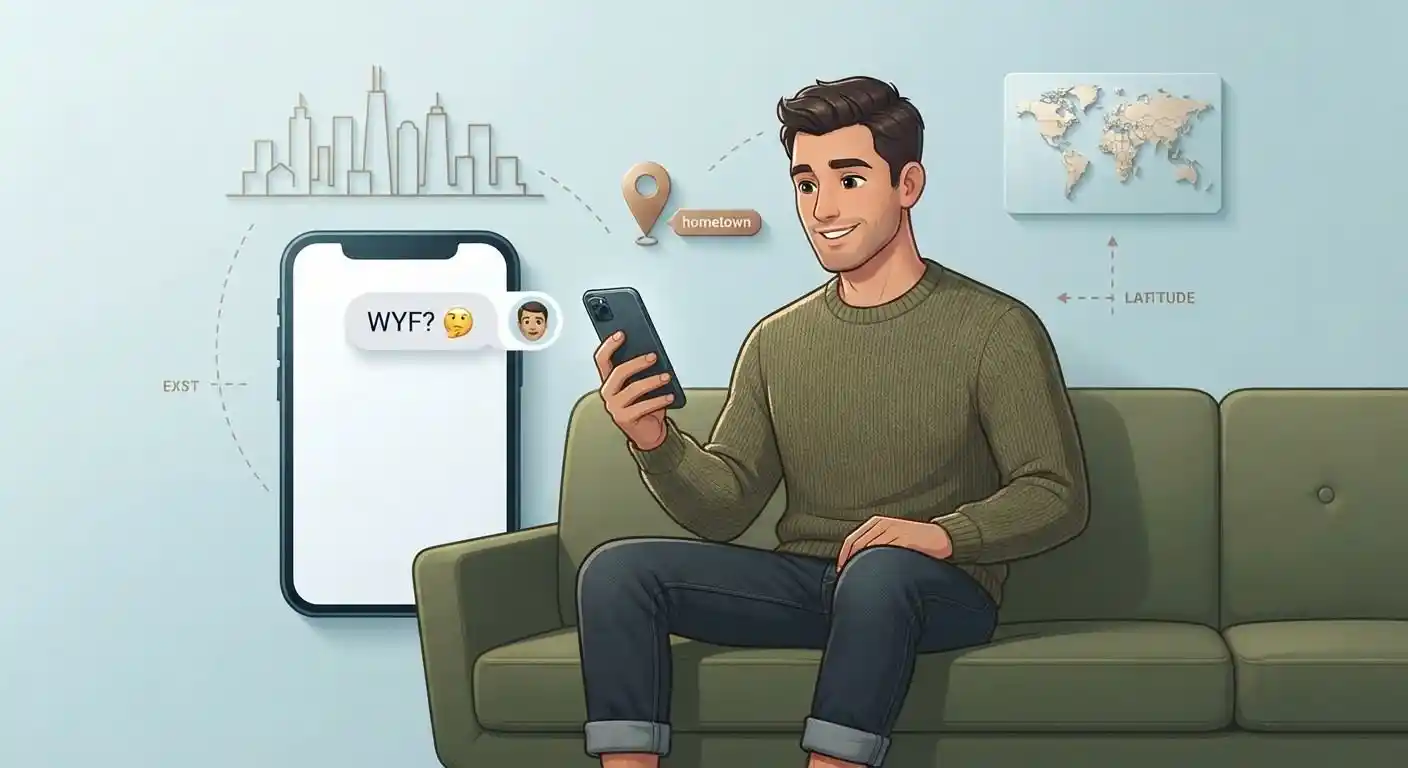
WYF in text usually means “Where You From?” It is an informal texting abbreviation used to ask where someone is from, such as their city, state, country, or hometown.
Key Takeaways
- WYF most commonly means “Where You From?”
- It is a casual form of the longer question “Where are you from?”
- You may see it in texts, DMs, group chats, social media, and dating conversations.
- The question usually asks about someone’s general location or background, not their exact address.
- WYF can have other meanings in certain contexts, including “What’s Your Favorite?” or “Who’s Your Favorite?”
- The surrounding conversation is the best way to determine which meaning the sender intends.
How Is WYF Used?WYF Meaning in Text
The main WYF meaning in text is “Where You From?” It is a short form of “Where are you from?” and is commonly used as casual messaging shorthand.
Someone might send “WYF?” when they want to know your hometown, city, state, country, or general background. For example:
“Hey, WYF?”
A natural response would be:
“I’m from Dallas. You?”
WYF is texting slang rather than standard written English. It fits casual conversations where people use shortened phrases to keep messages quick and informal.
The tone is usually casual, direct, and conversational. By itself, WYF does not automatically indicate flirting or romantic interest.
What Does WYF Stand For?
WYF stands for “Where You From?”
The letters can be understood as:
- W = Where
- Y = You
- F = From
In standard English, the complete question would normally be “Where are you from?” The shortened version leaves out “are,” which is common in informal internet slang.
WYF is better described as a texting abbreviation or initialism than as a formal acronym. People generally understand it from the context of a message rather than from formal language rules.
How Is WYF Used?
WYF is mainly used when someone wants to start or continue a casual conversation.
Text Messages
A person may use it when talking to someone they have recently met:
“Nice meeting you today. WYF?”
DMs
Someone may ask WYF when getting to know a new person through a direct message:
“You seem cool. WYF?”
Group Chats
In a group conversation, WYF can be used to learn where another member is from:
“I’m from Atlanta. WYF?”
Social Media
A person may use WYF in a comment or private message when they are curious about someone’s location or background.
Dating Conversations
On a dating app or in a new romantic conversation, WYF may be an easy way to begin learning more about the other person.
For example:
“Your profile caught my attention. WYF?”
That does not necessarily make the question romantic. The rest of the conversation provides the important context.
WYF in Different Contexts
The basic meaning stays the same in most casual conversations, but the reason someone asks can vary.
From a Friend
A friend may ask WYF simply because they are curious about your hometown or background.
“Wait, WYF? I never asked you.”
This is usually ordinary conversation.
From a Guy
If a guy texts “WYF?”, it generally means “Where You From?” His gender does not change the meaning of the abbreviation.
Whether he is being friendly, curious, or interested depends on the surrounding conversation.
From a Girl
The same applies when a girl sends WYF. It normally asks where you are from, regardless of whether the conversation is friendly or romantic.
From a Crush
If your crush sends “WYF?”, they may simply be trying to learn more about you.
The message alone does not prove attraction. Other messages, the relationship between you, and the overall tone matter more.
In Dating
WYF can be a natural conversation starter when two people have just connected online.
For example:
“Hey! WYF? I’m in Phoenix.”
It can help people learn about each other’s general background.
In a Relationship
Partners can also use WYF, although the question may sound unusual if they already know each other’s background. In that situation, context could point toward one of the alternative meanings.
In a Group Chat
A group chat with people from different places, WYF can simply be a quick way to ask about someone’s hometown or location.
In Social Media Comments
If someone comments “WYF?” under a post, they may be asking where the person is from. The exact interpretation depends on what the post is about.
Real Chat Examples
Here are realistic ways WYF can appear in conversations:

- Alex: “Hey, WYF?”
Jordan: “I’m from Miami.” - Sam: “You have a cool accent. WYF?”
- Taylor: “Just moved here last month.”
Chris: “Oh nice, WYF?” - Morgan: “WYF? I’m from Seattle.”
- Jamie: “We should grab coffee sometime. WYF?”
- Riley: “I’m from New York. WYF?”
- Casey: “Your profile says you travel a lot. WYF originally?”
- Drew: “Hey! WYF?”
- Avery: “You sound like you’re from the South. WYF?”
- Jordan: “WYF? I grew up in Chicago.”
- Taylor: “Nice meeting everyone here. WYF?”
- Morgan: “I’m from California. What about you?”
- Chris: “WYF? Your city looks beautiful.”
- Jamie: “We just matched. WYF?”
- Riley: “You’re new to the group, right? WYF?”
- Sam: “WYF? I’m originally from Boston.”
- Alex: “I’ve never been there. WYF?”
- Casey: “WYF lol?”
- Drew: “Where are you based? WYF?”
- Avery: “Hey, nice to connect. WYF?”
How to Reply to WYF
Your reply can be as simple or detailed as you want. Since WYF is informal, a short answer usually works well.
Casual Replies
- “I’m from Chicago. You?”
- “Texas. WYF?”
- “I’m from Denver.”
- “Originally from Boston.”
- “I’m from Atlanta, what about you?”
Friendly Replies
- “I’m from Seattle. Have you been there?”
- “I grew up in Miami. Where are you from?”
- “I’m from Austin. You?”
- “Originally from Philly, but I live in Dallas now.”
Funny Replies
- “Earth 😂”
- “A little place called Chicago.”
- “Somewhere with good food 😂”
- “Take a guess.”
- “The United States, detective 😂”
Neutral Replies
If you do not know the person well, you can keep your answer general:
- “I’m from Texas.”
- “I’m in California.”
- “I’m from the Midwest.”
- “I’m based in Florida.”
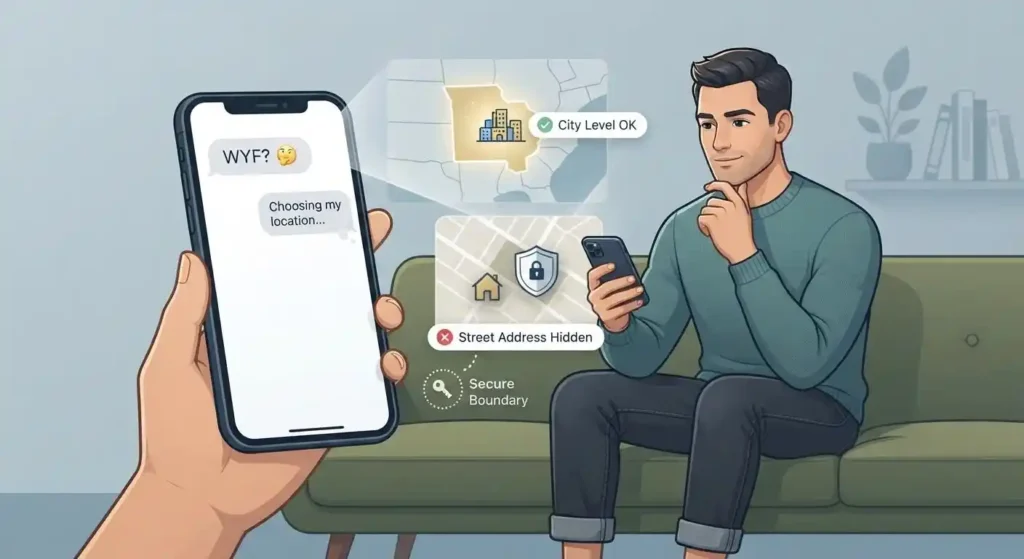
You do not have to provide your exact address or other private location details.
Flirty/Relationship Replies
If the conversation is already flirtatious, you can make the response playful:
- “I’m from Miami. Why, planning a visit?”
- “I’ll tell you if you tell me yours first 😉”
- “Chicago. What made you ask?”
- “I’m from Boston. Where are you from, cutie?”
The flirty tone comes from the reply and conversation, not from WYF itself.
What Tone Does WYF Have?
WYF is generally:
- Casual
- Informal
- Direct
- Conversational
- Context-dependent
A message such as “WYF?” can feel very brief because the sender has removed most of the words from the complete sentence.
That does not necessarily mean they are being rude. Texting abbreviations often make messages shorter without changing the sender’s attitude.
Punctuation can also affect how the message feels:
- “WYF?” — straightforward
- “wyf lol” — more relaxed
- “WYF 😂” — playful
- “Hey, WYF?” — friendlier and more conversational
Is WYF Rude or Offensive?
WYF is not inherently rude or offensive. Casual abbreviation for asking where someone is from.
It generally works in:
- Casual texts
- Conversations with friends
- DMs
- Group chats
- Informal social media conversations
- Casual dating conversations
It is less suitable for:
- Professional emails
- Formal letters
- Job applications
- Business documents
- Academic writing
In formal communication, write “Where are you from?” instead.
Also, remember that someone may not want to share their location or background. A person can simply give a general answer or decline to answer.
Other Meanings of WYF
Although “Where You From?” is the main texting meaning, WYF can have other interpretations in specific contexts.
WYF — What’s Your Favorite?
In a conversation about preferences, WYF can mean “What’s Your Favorite?”
For example:
“We’re talking about pizza. WYF?”
Here, the person is asking which pizza option you like best.
The topic makes this meaning easier to identify.
WYF — Who’s Your Favorite?
In a conversation about people, celebrities, characters, athletes, or performers, WYF may mean “Who’s Your Favorite?”
For example:
“We’re ranking the characters. WYF?”
In this case, the question is about your preferred person or character rather than where you are from.
WYF — World Youth Forum
World Youth Forum is another meaning associated with the abbreviation WYF, but this is a proper name rather than the usual texting interpretation.
If WYF appears in a discussion about an organization, event, or international youth gathering, the surrounding context can make this meaning clear.
Common Mistakes About WYF
Assuming WYF Always Means One Thing
“Where You From?” is the main texting interpretation, but context can change the meaning.
Confusing WYF With WYA
WYA usually means “Where You At?”, which asks about someone’s current location.
WYF usually asks “Where You From?”, which is about someone’s origin or background.
Assuming WYF Means “Where Are You?”
WYF is generally not the standard shorthand for “Where are you?” If someone wants to ask about your current location, WYA is a more direct texting abbreviation.
Assuming WYF Is Flirty
Someone asking WYF may simply be making conversation. The abbreviation itself does not prove romantic interest.
Giving Too Much Personal Information
If a stranger asks WYF, you can answer generally. You do not have to provide your street address, workplace location, or other private details.
WYF and Related Slang
| Term | Meaning | Common Use |
|---|---|---|
| WYF | Where You From? | Asking about someone’s origin |
| WYA | Where You At? | Asking someone’s current location |
| WYD | What You Doing? | Asking what someone is doing |
| WBU | What About You? | Returning a question |
| HBU | How About You? | Asking for the other person’s answer |
The most important distinction is between WYF and WYA. If someone asks “WYF?”, they generally want to know where you are from. If they ask “WYA?”, they are usually asking where you are right now.
People Also Ask About WYF
Does WYF mean “Where You From”?
Yes. In casual texting, WYF most commonly means “Where You From?” It is a shortened way to ask where someone is from, such as their city, state, country, or hometown.
What does WYF mean on Snapchat?
On Snapchat, WYF generally means “Where You From?” The sender is usually asking about your background or where you are from. Context can occasionally point to another meaning.
Is WYF the same as WYA?
No. WYF usually means “Where You From?” while WYA usually means “Where You At?” WYF is generally about origin or background, whereas WYA asks about someone’s current location.
Does WYF mean “What’s Your Favorite?”
It can. In a conversation about preferences, WYF may be interpreted as “What’s Your Favorite?” However, when someone sends WYF without additional context, “Where You From?” is the more likely texting meaning.
Is WYF a question?
Yes. WYF is normally used as a shortened question. It can appear as “WYF?” or simply “WYF” without a question mark in casual messages.
Does WYF mean someone likes you?
Not necessarily. Someone asking WYF may simply be trying to learn where you are from. Romantic interest can only be inferred from the broader conversation and relationship context, not from WYF alone.
Should I answer WYF?
If you are comfortable sharing where you are from, a simple response such as “I’m from Chicago. You?” works well. If you do not know the person or prefer privacy, you can give a general location or choose not to answer.
Conclusion
WYF in text usually means “Where You From?” It is an informal messaging abbreviation used to ask about someone’s hometown, city, state, country, or general background.
The term is casual and works well in texts, DMs, group chats, social media, and other informal conversations. It is not appropriate for formal writing, where “Where are you from?” is clearer.
Context still matters because WYF can occasionally mean “What’s Your Favorite?” or “Who’s Your Favorite?” The surrounding conversation usually reveals which interpretation makes sense.

Mila Parker brings three years of writing experience to the craft of puns, jokes, and concise wordplay. Her subject range moves through food, animals, seasonal themes, technology, entertainment, and trending topics. She studies relevant terminology, connects words through double meanings and associations, then adjusts setups and punchlines to keep each joke clear and well structured.