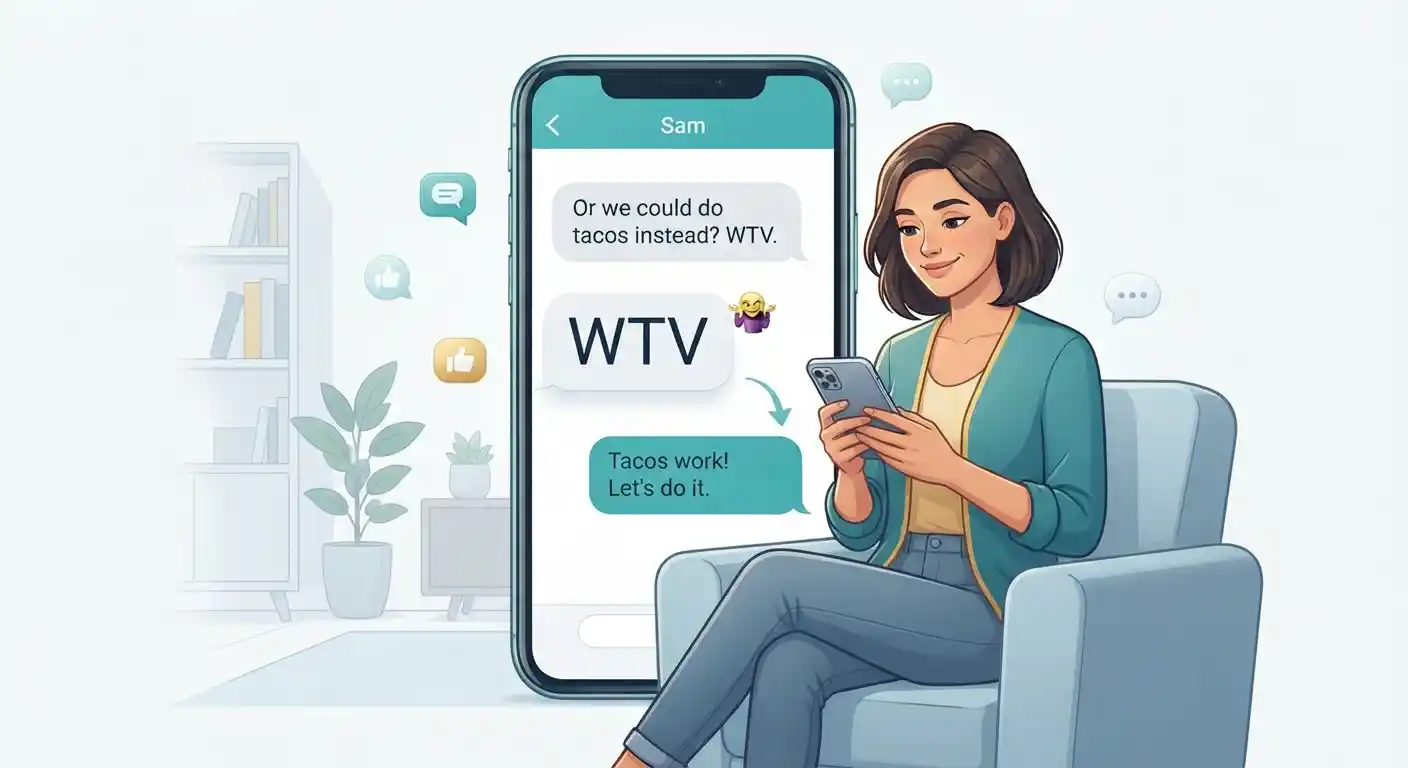
WTV means “whatever” in text, chat, and social media. It is an informal texting abbreviation used to show indifference, flexibility, acceptance, or a desire to move on from a topic. Depending on context, it can sound casual, playful, dismissive, or mildly annoyed.
Key Takeaways
- WTV stands for “whatever.”
- It is a casual texting abbreviation used in messages, DMs, group chats, and social media.
- WTV can mean “I don’t mind,” “it’s up to you,” or “I don’t care,” depending on context.
- A standalone “wtv” can sound dismissive, especially during an argument.
- It does not automatically mean someone is angry, uninterested, or being rude.
- The sender’s wording, punctuation, emojis, relationship, and previous messages can help reveal the intended tone.
WTV Meaning in Text
The most common WTV meaning in text is “whatever.” It is a shortened form of the word used in informal digital communication.
Someone might use WTV when they have no strong preference, want another person to choose, do not think something is important, or do not want to continue discussing a subject.
For example:
“Where should we eat?”
“WTV, you pick.”
Here, WTV means “whatever” in the sense of “I’m fine with any choice.”
But consider:
“WTV. I’m done arguing.”
In this situation, WTV sounds much more dismissive. The abbreviation itself has not changed; the surrounding conversation changes how it is understood.
WTV is best treated as informal internet slang and messaging shorthand, rather than language for professional or formal communication.
What Does WTV Stand For?
WTV stands for “whatever.”
It is not normally a separate phrase with a complicated acronym expansion. In texting, WTV is simply a shortened way to write “whatever.”
The abbreviation can represent several closely related ideas:
- “Whatever you want.”
- “I don’t mind.”
- “It doesn’t matter.”
- “I don’t care.”
- “Let’s drop it.”
- “I’m not going to argue about this.”
The exact interpretation depends on the conversation.
How Is WTV Used?
WTV is mainly used in casual online communication where people want to keep messages short.
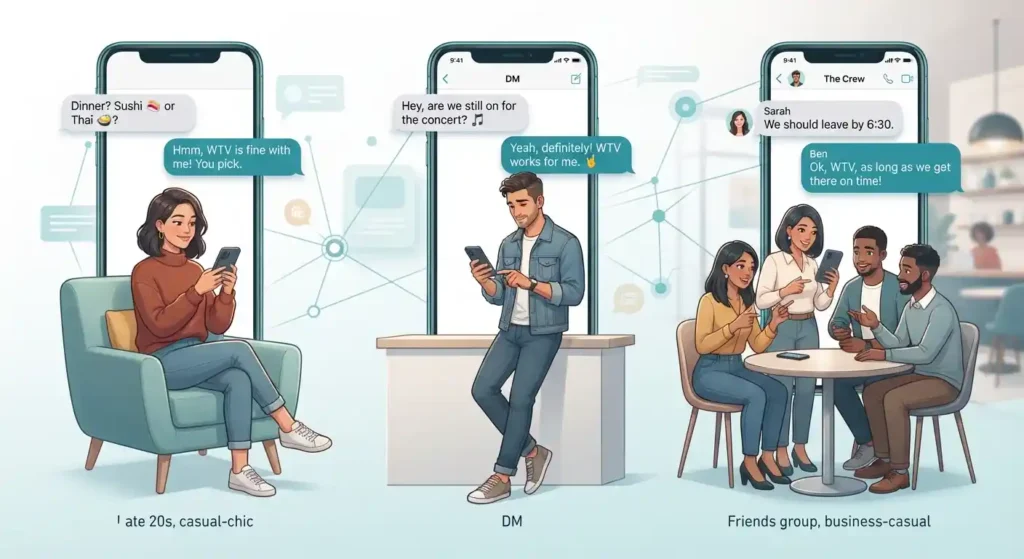
Text Messages
A person might use WTV when responding to a question or choice.
“Pizza or tacos?”
“WTV works.”
Here, it means either option is fine.
DMs
In a direct message, WTV can be used casually between friends or acquaintances.
“Are you still mad?”
“Wtv lol.”
The “lol” can make the response feel less serious, although context still matters.
Group Chats
WTV can help someone step out of a debate or leave a decision to other people.
“Should we go at 7 or 8?”
“WTV, I’m good either way.”
Social Media
You may also see WTV in casual comments, replies, captions, or conversations on social platforms. Its meaning remains essentially the same: “whatever.”
The abbreviation is generally not appropriate for formal emails, professional messages, applications, or other situations where standard language is expected.
WTV in Different Contexts
WTV does not have a different basic meaning depending on who sends it. A guy, girl, friend, crush, or partner can all use WTV to mean “whatever.”
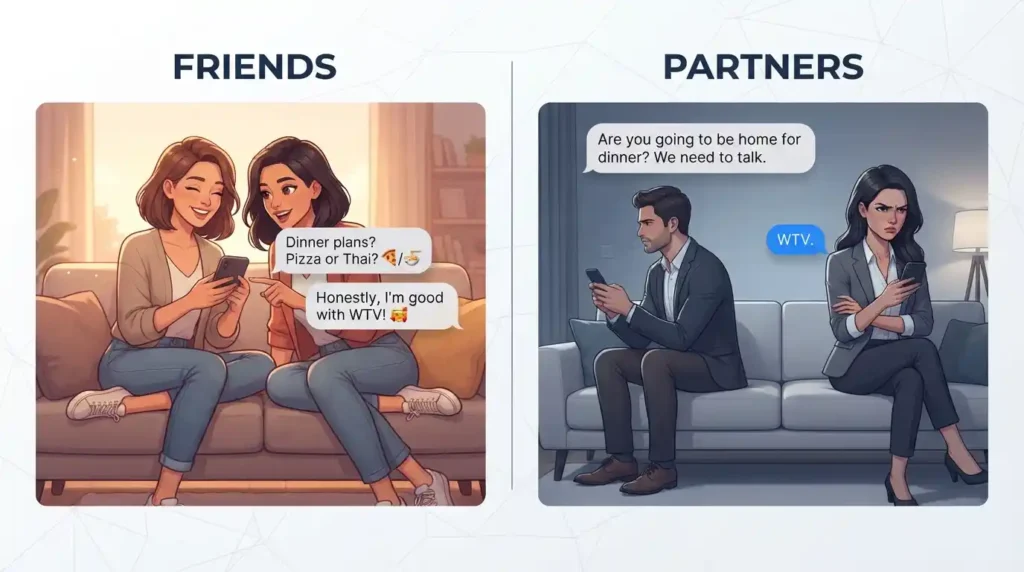
What changes is the context and tone.
From a Friend
A friend might use WTV simply to show flexibility.
“Movie or bowling?”
“WTV, both sound fun.”
This is likely casual and low-stakes.
From a Guy or Girl
The sender’s gender does not automatically change the meaning of WTV. Look at the surrounding messages instead.
For example:
“What do you want to do tonight?”
“WTV, you choose 😂”
This may simply mean the person does not have a preference.
From a Crush
WTV by itself does not prove flirting, attraction, rejection, or disinterest.
If a crush says:
“WTV 😂 you decide.”
It could simply mean they are letting you choose. The rest of the conversation is more useful for understanding the tone.
In Dating
During casual planning, WTV can mean:
“WTV works for me.”
That usually communicates flexibility.
During an argument, however:
“WTV. Do what you want.”
can sound much colder or more dismissive.
In a Relationship
Partners may use WTV playfully or casually, but a standalone WTV during a disagreement can feel like the sender is shutting down the conversation.
Do not assume that WTV means someone is upset. Check what happened immediately before the message.
In a Group Chat
WTV can signal that someone does not want to choose between options or continue a debate.
“WTV guys, I’ll go with whatever everyone picks.”
In Social Media Comments
A comment such as “wtv 😂” may communicate indifference or playful dismissal. The surrounding comment thread can make the intended meaning clearer.
Real Chat Examples
Here are realistic ways WTV can appear in everyday conversations:
- Friend: “Pizza or burgers?”
You: “WTV, I’m hungry 😂” - Friend: “What time should we meet?”
You: “WTV works for me.” - Person A: “Do you want the blue one or black one?”
Person B: “WTV, you choose.” - Friend: “Are you watching the game tonight?”
You: “WTV, maybe.” - Person A: “Should I text him?”
Person B: “WTV you think is best.” - Friend: “You still mad?”
You: “Wtv lol.” - Person A: “Movie or dinner?”
Person B: “WTV, I’m down for either.” - Friend: “Are we going Friday or Saturday?”
You: “WTV works.” - Person A: “Why did you leave early?”
Person B: “WTV, I was tired.” - Friend: “Everyone wants tacos.”
You: “WTV, tacos are fine.” - Person A: “You pick the restaurant.”
Person B: “WTV, anywhere is good.” - Friend: “I thought you said you liked it.”
You: “Wtv 😂” - Person A: “Should we invite them?”
Person B: “WTV, it’s your call.” - Friend: “Can we talk about this later?”
You: “WTV.” - Person A: “I’m not changing my mind.”
Person B: “WTV. Do what you want.” - Friend: “Which outfit looks better?”
You: “WTV, both look good.” - Person A: “Want to play another round?”
Person B: “WTV, sure.” - Friend: “Are you seriously still arguing about this?”
You: “WTV 😭” - Person A: “Should I order now?”
Person B: “WTV, go ahead.” - Friend: “So are you coming or not?”
You: “WTV, I might.”
How to Reply to WTV
The best response depends on whether WTV sounds relaxed, playful, neutral, or dismissive.
Casual Replies
- “Cool, I’ll decide.”
- “Sounds good.”
- “Okay, I got you.”
- “Works for me.”
- “Alright, your call.”
Friendly Replies
- “Haha, fair enough.”
- “Okay 😂”
- “No worries.”
- “We’ll figure it out.”
- “Either way works.”
Funny Replies
- “That’s a very detailed answer 😂”
- “Wow, such strong opinions 😭”
- “I’ll take that as a yes.”
- “The enthusiasm is unmatched 😂”
- “Okay, Mr./Ms. Whatever 😭”
Neutral Replies
If you are unsure whether the person is annoyed, keep your response simple:
- “Okay.”
- “Got it.”
- “No problem.”
- “What do you prefer?”
- “Are you good with that?”
Flirty/Relationship Replies
If the conversation is already romantic, you can keep the reply light without assuming what WTV means:
- “I’ll choose then 😉”
- “Fine, but you’re coming with me.”
- “Okay, I’ll make the decision for us.”
- “You’re making this way too easy 😂”
If WTV appeared during an argument, it is usually better to clarify rather than immediately flirt.
What Tone Does WTV Have?
WTV is context-dependent. Its tone can range from completely relaxed to noticeably dismissive.
Casual
“WTV, I’m free tonight.”
The person may simply be flexible.
Neutral
“WTV works.”
This can mean the person accepts the option without having a strong preference.
Playful
“WTV 😂”
An emoji or joking context can make the abbreviation feel lighthearted.
Dismissive
“WTV. I’m not talking about this anymore.”
Here, the person is clearly trying to end the discussion.
Mildly Annoyed
“WTV, you never listen anyway.”
In this example, the surrounding words—not WTV alone—make the frustration clear.
A useful rule is: do not interpret WTV in isolation. Look at what was said before it and whether the sender added punctuation, emojis, explanations, or other words.
Is WTV Rude or Offensive?
WTV is not inherently rude or offensive. It is ordinary informal shorthand for “whatever.”
However, it can sound rude or dismissive in certain situations.
With friends, it may be completely harmless:
“WTV, you pick 😂”
During a serious conversation, the same abbreviation may feel much colder:
“WTV. I don’t care anymore.”
For school, work, customer service, professional communication, or formal writing, it is better to write “whatever,” “either is fine,” or another clearer phrase instead.
Other Meanings of WTV
In ordinary texting and social-media slang, “whatever” is the meaning that matters most.
The letters WTV can represent different things in specialized fields or organizations, but those meanings depend on the subject being discussed. If you encounter WTV in a technical, professional, medical, or industry-specific document, do not automatically assume it means “whatever.”
The surrounding topic should determine whether WTV is being used as texting slang or as a specialized abbreviation.
Common Mistakes About WTV
Assuming WTV Always Means “I Don’t Care”
Sometimes WTV means genuine indifference, but it can also mean “you choose,” “either is fine,” or “let’s move on.”
Assuming WTV Means Someone Is Angry
A standalone WTV can sound annoyed, but the abbreviation alone does not prove anger.
Assuming WTV Is Flirty
WTV does not inherently communicate romantic interest. If it appears in a conversation with a crush or partner, consider the entire exchange.
Treating WTV as Formal Language
WTV is casual messaging shorthand. It is not a good choice for professional or formal communication.
Confusing WTV With Similar Slang
Closest to “whatever,” while terms such as IDC and NVM have related but different meanings.
WTV and Related Slang
| Term | Meaning | Common Use |
|---|---|---|
| WTV | Whatever | Indifference, flexibility, or dismissal |
| IDC | I don’t care | Directly expressing lack of concern |
| NVM | Never mind | Dropping or withdrawing a previous thought |
| IDK | I don’t know | Expressing uncertainty or lack of knowledge |
| TBH | To be honest | Introducing a candid opinion |
IDC and WTV can sometimes appear in similar situations, but they are not identical. WTV can mean “whatever” or “you choose,” while IDC more directly says “I don’t care.”
People Also Ask About WTV
What does WTV mean in a text message?
WTV usually means “whatever.” It is an informal abbreviation used to express indifference, flexibility, acceptance, or dismissal depending on the conversation.
Is WTV the same as whatever?
Yes. In texting and online communication, WTV is simply a shortened form of “whatever.” The abbreviation is more casual and can sometimes sound more abrupt than the full word.
Does WTV mean “I don’t care”?
It can. WTV may communicate “I don’t care,” but it can also mean “I don’t mind,” “you decide,” or “either option is fine.”
Is WTV rude?
Not necessarily. WTV can be perfectly casual among friends, but a standalone WTV during an argument or serious conversation may sound dismissive.
What does WTV mean from a crush?
WTV still means “whatever.” It does not automatically indicate flirting, rejection, or attraction. The surrounding conversation and relationship provide more useful clues.
Can WTV mean something other than “whatever”?
In texting, “whatever” is the primary meaning. In specialized settings, the same letters may represent another abbreviation, so the subject and context should be checked before interpreting it.
How do you respond to WTV?
Match the context. If it sounds casual, you can say “sounds good” or “you pick.” If it sounds irritated, a simple “Are you okay?” or “Did I misunderstand?” can clarify the situation.
Conclusion
WTV means “whatever” in text, chat, and social media. It is informal messaging shorthand that can express indifference, flexibility, acceptance, or dismissal. Its tone can be casual, playful, neutral, or mildly annoyed depending on the conversation.
WTV is fine for casual conversations but is better avoided in professional or formal writing. Most importantly, do not assume that WTV automatically means someone is angry, rude, or uninterested. The surrounding words, punctuation, emojis, relationship, and conversation topic provide the real context.

Mila Parker brings three years of writing experience to the craft of puns, jokes, and concise wordplay. Her subject range moves through food, animals, seasonal themes, technology, entertainment, and trending topics. She studies relevant terminology, connects words through double meanings and associations, then adjusts setups and punchlines to keep each joke clear and well structured.