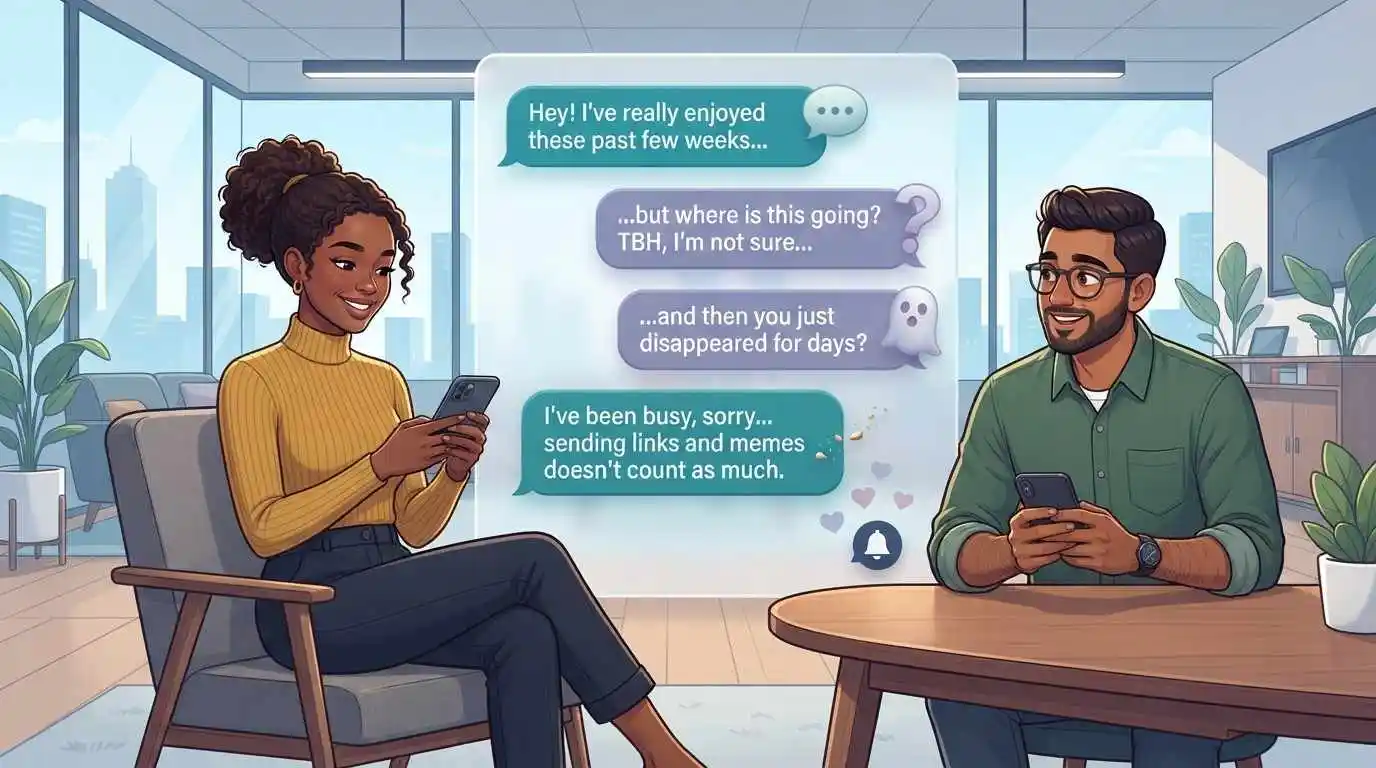
Relationship slang refers to informal words, phrases, and abbreviations used to describe dating, romance, relationship status, attraction, communication patterns, and situations between people. You may see it in texts, DMs, dating apps, group chats, and social media.
Key Takeaways
- Relationship slang describes romantic situations, dating stages, behaviors, feelings, and relationship status.
- It is not one specific acronym or abbreviation, so “relationship slang” has no fixed full form.
- Common examples include talking stage, situationship, ghosting, breadcrumbing, soft launch, DTR, FWB, and cuffing.
- The same term can feel playful, neutral, serious, or negative depending on the conversation.
- A slang term alone does not prove that someone is flirting, in love, rejecting you, or interested romantically.
- Context, previous messages, punctuation, emojis, and the relationship between the people involved can change how a phrase should be understood.
Relationship Slang Meaning in Text
In texting and online communication, relationship slang means casual language used to talk about dating and romantic connections without using formal relationship terminology.
It can describe where two people stand, such as being in the talking stage or a situationship. It can also describe a behavior, such as ghosting or breadcrumbing, or an online action, such as a soft launch.
Relationship slang is generally informal text slang and internet slang. It appears naturally in text messages, DMs, comments, dating conversations, and social media posts.
Some terms are abbreviations, such as DTR for “define the relationship” and FWB for “friends with benefits.” Others are ordinary words or phrases that have developed a specific dating meaning, such as “ghosting” or “soft launch.”
The meaning is often context-dependent. A person saying “we need to DTR” is discussing relationship expectations, while “I got ghosted” describes a communication pattern.
What Does Relationship Slang Stand For?
Relationship slang does not stand for a specific phrase. It is a broad category, not a traditional acronym.
The phrase combines:
- Relationship — a connection between people, especially a romantic one in this context
- Slang — informal language used in casual communication
So, “relationship slang” simply means informal language used to discuss dating and romantic relationships.
Individual relationship slang terms can have their own full forms. For example:
- DTR = Define the relationship
- FWB = Friends with benefits
- BF = Boyfriend
- GF = Girlfriend
- ILY = I love you
Not every relationship term is an abbreviation. “Situationship,” “ghosting,” “breadcrumbing,” and “talking stage” are examples of relationship slang that do not have a traditional acronym-style expansion.
How Is Relationship Slang Used?
Relationship slang can appear in several kinds of online communication.

Text Messages
People use it to describe their dating status or what happened with someone.
“I think we’re officially in the talking stage.”
“He ghosted me after the second date.”
DMs
Dating and relationship slang can make a longer explanation shorter and more conversational.
“Should we DTR?”
“Is this a situationship?”
Group Chats
Friends often use relationship slang when discussing someone else’s dating life.
“Girl, that’s not a relationship. That’s a situationship.”
Social Media
Terms such as “soft launch,” “hard launch,” and “ship” can appear in captions, comments, posts, and discussions about couples.
Dating Conversations
Slang can help people describe unclear or changing relationship stages.
“We’re seeing each other, but we’re not exclusive.”
“We’re past the talking stage now.”
The best term depends on what is actually happening. Using a dating label simply because it sounds familiar can create confusion.
Relationship Slang in Different Contexts
The meaning of relationship slang can change depending on the situation.
From a Friend
A friend might use relationship slang casually while giving you advice.
“Sounds like you’re in a situationship.”
That does not necessarily mean the friend is criticizing the relationship.
From a Guy
A guy using relationship slang may simply be describing a dating situation.
For example:
“I’m still in the talking stage with her.”
The phrase alone does not prove romantic seriousness or a particular level of attraction.
From a Girl
The same principle applies when a girl uses relationship slang.
“We’re keeping it casual right now.”
Her wording describes the situation, but the surrounding conversation is important for understanding exactly what she means.
From a Crush
If a crush says:
“We’re basically in the talking stage.”
that may indicate romantic interest, but it does not automatically establish exclusivity or a committed relationship.
In Dating
Relationship slang can make distinctions between early dating, casual dating, undefined connections, and committed relationships.
In a Relationship
Some terms describe what happens after two people become official, including relationship reveals, public posts, and discussions about commitment.
In a Group Chat
Friends may use slang humorously or exaggerate a situation. A term used as a joke should not automatically be treated as a literal relationship label.
In Social Media Comments
A comment such as:
“I ship you two.”
usually expresses support for a potential or existing couple. It does not mean the commenter knows what is actually happening privately.
Real Chat Examples
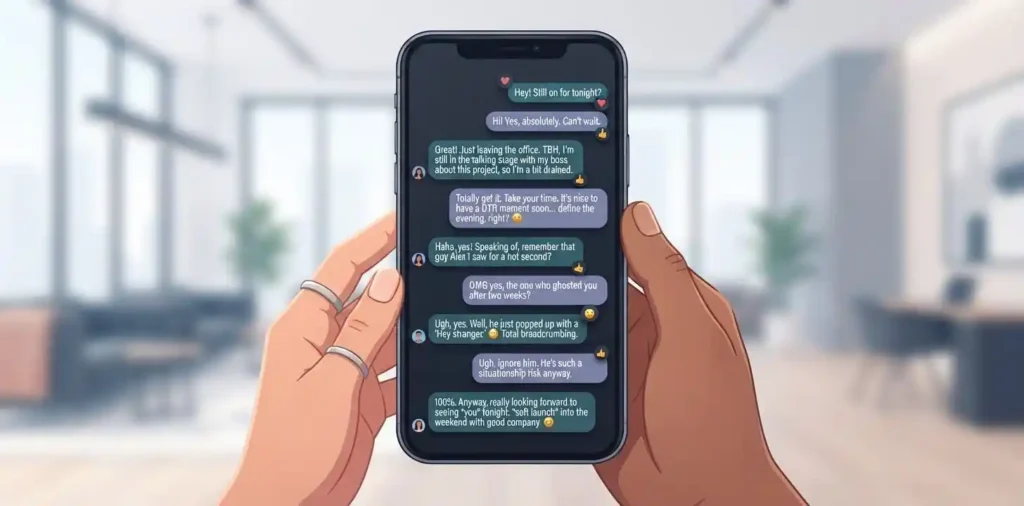
Here are realistic ways relationship slang can appear in everyday conversations:
- “Are you guys dating?”
“Not officially. We’re still in the talking stage.” - “What happened with Alex?”
“He ghosted me after we went out twice.” - “So what are you two?”
“Honestly, it’s kind of a situationship.” - “Did you tell people you’re together?”
“Not yet. We’re doing a soft launch first.” - “Why haven’t you made it official?”
“We haven’t had a DTR conversation.” - “She keeps texting but never makes plans.”
“That sounds like breadcrumbing.” - “Are you exclusive?”
“No, we’re just seeing each other.” - “Is that your boyfriend?”
“Not exactly. We’re talking.” - “Do you think they’re cute together?”
“I totally ship them.” - “Why does he keep watching your stories?”
“I don’t know. We don’t even talk anymore.” - “Are you two back together?”
“We’re talking again, but nothing is official.” - “What’s your relationship status?”
“It’s complicated.” - “Are you looking for something serious?”
“Eventually, but I’m okay with taking things slowly.” - “Did she introduce you to her friends?”
“Yeah, I think we’re getting more serious.” - “Why did you stop replying?”
“I wasn’t trying to ghost you. I got busy.” - “You posted his hand in your story.”
“Yep, that’s my soft launch.” - “When are you making it official?”
“We’re not rushing it.” - “Are you guys exclusive now?”
“Yeah, we talked about it last night.” - “He sends me random compliments but never asks me out.”
“That sounds like breadcrumbing.” - “So, are you single?”
“Technically, yes. I’m just seeing someone.”
How to Reply to Relationship Slang
If someone uses relationship slang with you, your reply should match the specific term and the tone of the conversation.
Casual Replies
- “Yeah, that sounds about right.”
- “I guess we’re in that stage.”
- “That’s basically what I’ve been calling it.”
- “Yeah, we’re keeping things casual.”
Friendly Replies
- “Haha, that’s actually a good way to describe it.”
- “I know what you mean.”
- “Yeah, it’s a little complicated right now.”
- “We’re still figuring things out.”
Funny Replies
- “Apparently we’re in relationship limbo.”
- “So basically, nobody knows what’s happening.”
- “Our relationship needs a software update.”
- “We’re somewhere between a date and a documentary.”
Neutral Replies
- “I’m not sure how I’d label it yet.”
- “We’re getting to know each other.”
- “I think it’s too early to call it a relationship.”
- “We haven’t talked about labels.”
Flirty/Relationship Replies
When the conversation is clearly romantic, you could say:
- “Maybe we should finally define this.”
- “I was wondering when you’d bring that up.”
- “I’d say we’re getting pretty close.”
- “Maybe it’s time for that DTR talk.”
What Tone Does Relationship Slang Have?
Relationship slang does not have one fixed tone because it covers many different expressions.
It can be:
- Casual — “We’re just seeing each other.”
- Playful — “We’re in our talking-stage era.”
- Friendly — “I totally ship you two.”
- Neutral — “We’re not exclusive.”
- Direct — “We should DTR.”
- Negative — “I got ghosted.”
- Sarcastic — depending on how the speaker uses the term
- Context-dependent — especially when slang is used jokingly
The same phrase can feel completely different depending on who says it and why.
For example, calling a connection a “situationship” may be a neutral description in one conversation but express frustration in another.
Is Relationship Slang Rude or Offensive?
Most relationship slang is casual rather than inherently rude or offensive. It is generally suitable for conversations with friends, social media, texts, and informal dating discussions.
However, some terms describe sensitive or personal situations. Calling someone’s relationship a “situationship,” “hookup,” or another label without knowing how the people involved define it can come across as judgmental.
Relationship slang is usually less appropriate in:
- Professional emails
- Workplace communication
- Formal documents
- Academic writing
- Official relationship-related paperwork
For formal communication, plain language is usually clearer.
Other Meanings of Relationship Slang
“Relationship slang” itself does not have a major alternative technical meaning. It is primarily a broad phrase for informal vocabulary connected with relationships and dating.
However, individual relationship slang terms can have different meanings outside dating.
For example, an abbreviation may have a technical or professional meaning in another field. This is why the surrounding conversation matters when interpreting short abbreviations.
A message containing only a few letters may not be enough to determine the intended meaning without context.
Common Mistakes About Relationship Slang
Assuming One Term Has One Universal Meaning
Some slang can have different interpretations depending on the conversation. Always check the surrounding words.
Treating Slang as Proof of Romantic Interest
A person using dating slang does not automatically mean they are flirting or expressing romantic feelings toward you.
Confusing the Talking Stage With a Relationship
The “talking stage” generally refers to an early period of getting to know someone romantically. It does not automatically mean the two people are an official couple.
Treating a Situationship as the Same as Casual Dating
These terms can overlap, but they are not identical. Casual dating can involve clearly understood expectations, while “situationship” commonly points to an undefined romantic connection.
Assuming a Soft Launch Means a Serious Commitment
A soft launch can indicate that someone is gradually revealing a relationship online, but a social media post alone does not establish the couple’s private expectations.
Using Slang in Formal Communication
Terms that sound natural in a DM may sound inappropriate or unclear in a workplace email or formal document.
Relationship Slang and Related Terms
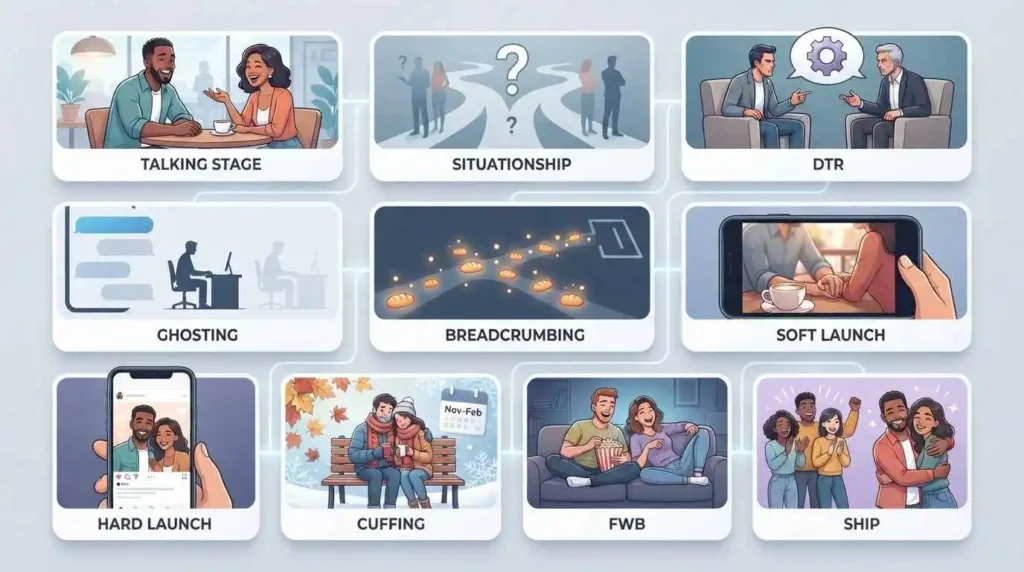
| Term | Meaning | Common Use |
|---|---|---|
| Talking stage | Early romantic stage before an official relationship | Getting to know someone |
| Situationship | Romantic connection without a clearly defined relationship status | Undefined dating |
| DTR | Define the relationship | Discussing labels or expectations |
| Ghosting | Suddenly stopping communication | Dating or messaging |
| Breadcrumbing | Giving occasional attention without meaningful progress | Dating behavior |
| Soft launch | Subtly revealing a romantic relationship online | Social media |
| Hard launch | Publicly revealing a relationship more directly | Social media |
| Cuffing | Seeking a romantic partner, often associated with a particular season | Dating culture |
| FWB | Friends with benefits | Casual adult relationship |
| Ship | Support or root for two people as a couple | Social media and fandom |
People Also Ask About Relationship Slang
What is relationship slang?
Relationship slang is informal language used to describe dating, romantic connections, relationship status, and behaviors between people. It includes both abbreviations and ordinary words with dating-specific meanings.
What are examples of relationship slang?
Common examples include talking stage, situationship, ghosting, breadcrumbing, DTR, soft launch, hard launch, FWB, cuffing, and ship. Each describes a different situation, behavior, or relationship concept.
What does DTR mean in a relationship?
DTR means “define the relationship.” It refers to a conversation about what two people are, whether they are exclusive, and what they expect from the connection.
What is a situationship?
A situationship is an undefined romantic connection that does not have a clearly established relationship label or direction. It can involve dating, emotional closeness, physical intimacy, or some combination of these.
What does “talking stage” mean?
The talking stage generally describes an early period when two people are getting to know each other with possible romantic interest but have not established an official relationship. The exact boundaries can vary between people.
What does “soft launch” mean in dating?
A soft launch is a subtle way of revealing a romantic relationship on social media without making a full public announcement. Someone might post a partial photo, shared activity, or another indirect clue.
Does relationship slang always mean romantic interest?
No. Relationship slang is often used to discuss romantic situations, but using a particular term does not by itself prove someone’s feelings or intentions. Context and direct communication provide better clues.
Why is relationship slang confusing?
Many terms describe stages or behaviors that do not have strict boundaries. People may also use the same word differently, jokingly, or according to their own understanding of the relationship.
Conclusion
Relationship slang is a broad category of informal language used to discuss dating, romance, relationship status, and communication patterns. It is not a specific acronym and has no single full form.
Terms such as talking stage, situationship, DTR, ghosting, breadcrumbing, soft launch, and FWB each describe different relationship situations. Most are casual and work best in texts, DMs, social media, and conversations with friends.
The key to understanding relationship slang is context. Consider the wording, previous messages, emojis, relationship between the people, and topic before assuming what someone means. When a term is unclear, asking directly is usually more reliable than reading a romantic meaning into the slang itself.

Christopher Hayes has spent five years writing puns and jokes built around the language of specific subjects. His work spans animals, seasonal themes, technology, entertainment, trending topics, and food-related wordplay. He examines terminology and possible word connections, builds joke premises from them, and fine-tunes setups and punchlines for precision, rhythm, and comedic effect.